Picture this. You run the washing machine and the toilet in the hall bathroom starts gurgling. You turn on the kitchen faucet and the shower drain bubbles. Every drain in your home is moving slowly, not just one. That is not a clogged drain. That is your sewer line talking, and understanding the sewer line repair cost before you call anyone is the smartest first move you can make.
This guide walks you through how to read those warning signs, what drives repair costs in Mesa, and how to get an honest estimate without overpaying.
When Every Drain in Your Mesa Home Slows Down at Once, Your Sewer Line Is Talking
A single slow drain usually points to a local clog, something you can clear with a drain snake or a plunger. When multiple drains slow down or back up at the same time, the problem is downstream of all of them. That means the main sewer line, the single pipe that carries all wastewater from your home to the city connection at the street.
Mesa homeowners in older subdivisions near Dobson Ranch, Fiesta District, and Alma School Road are especially familiar with this scenario. Many of those neighborhoods were built before 2000 using clay or Orangeburg sewer pipe. Orangeburg was a compressed wood pulp and pitch material used widely through the mid-1970s. It was never meant to last more than 50 years, and it is well past that now. Clay pipe holds up longer but is brittle and vulnerable to root intrusion from the mature citrus trees and block-wall-adjacent plantings common in East Valley yards.
The gurgling toilet when the washer drains is one of the clearest signals. Wastewater is looking for any exit it can find, and that means air is being pushed back up through your drain traps. Pay attention to that sound. It is not a quirk. It is a diagnostic.
How to Diagnose Whether You Have a Sewer Line Problem or Something Smaller
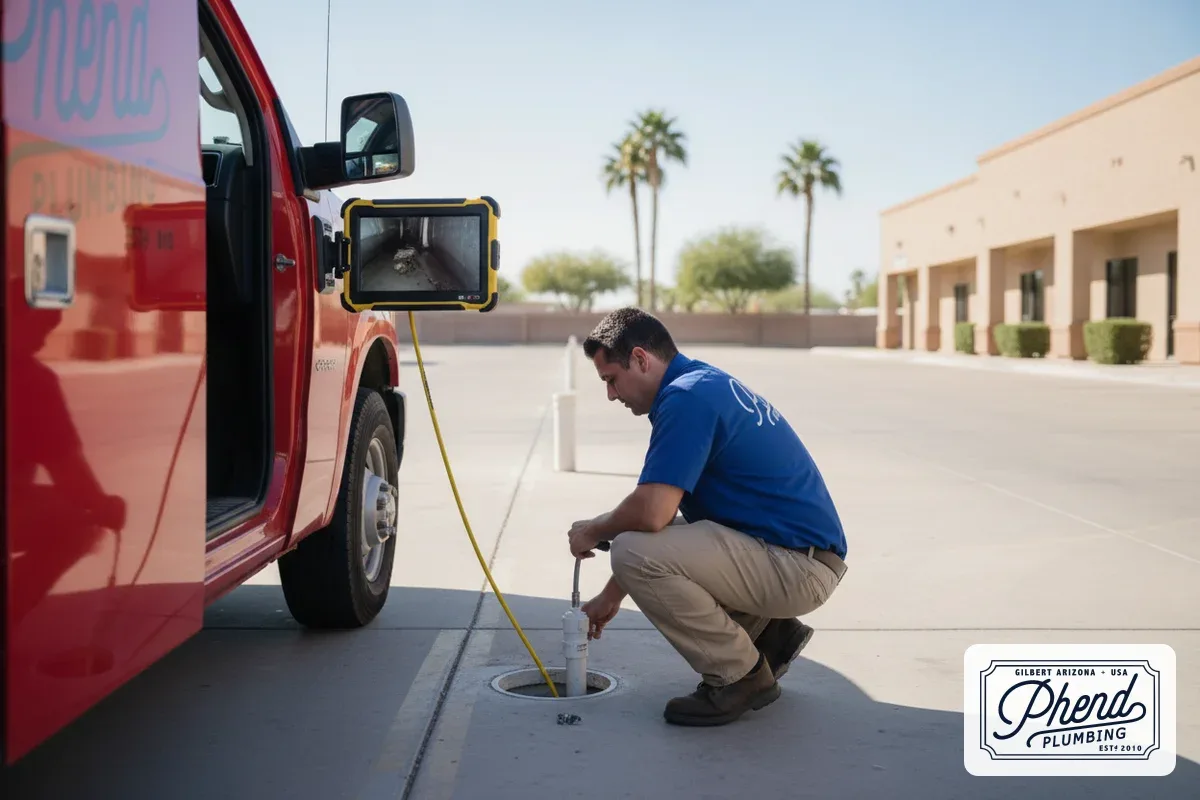
Before anyone quotes you a repair price, the right plumber will want to run a sewer camera inspection. A camera is threaded into the cleanout, which is usually a capped pipe near your foundation or in the yard, and it gives a live video feed of the inside of your sewer line. There is no guesswork involved.
The camera will show you exactly what you are dealing with: a root ball at a specific joint, a collapsed section from ground movement, an offset caused by soil shifting, or a belly (a low spot where the pipe sags and waste pools). Each of those problems has a different repair path and a different cost.
Skipping the camera inspection to save the inspection fee almost always costs more in the end. A plumber who quotes a repair without a camera is guessing, and guesses in underground plumbing tend to run over budget. The National Association of Sewer Service Companies recommends camera inspection as the baseline diagnostic for any main line evaluation, and we agree completely.
If the camera shows a single isolated problem in an otherwise sound pipe, you are looking at a targeted repair. If it shows widespread deterioration, root intrusion along the full run, or a pipe material that has reached the end of its service life, the honest answer may be full replacement. We will tell you which one applies to your situation before we touch a shovel.
What Drives Sewer Line Repair Costs in Mesa, Arizona
According to Contractor+ cost data updated July 2026, the average cost to repair a sewer pipe in Mesa is approximately $1,483. Labor runs around $87 per hour and a typical repair requires roughly 12 hours of work. On the materials side, 4-inch PVC sewer pipe runs $0.20 to $0.40 per linear foot, PVC couplings cost $3 to $7 each, and primer and cement sets are $10 to $20. On a 20-linear-foot repair, materials can stay under $200, which means labor and equipment dominate the total.
So what moves that number up or down for your specific job?
Depth of the pipe. Mesa sewer lines are typically buried 4 to 6 feet deep, but some older installations run deeper. Every additional foot of depth adds shoring time and labor cost.
Pipe length affected. A one-foot crack at a single joint is a very different job than 40 feet of deteriorated Orangeburg.
Access to the cleanout. If your home lacks an accessible cleanout or the existing one is buried under concrete, adding or exposing one adds to the job.
Surface restoration. This is where costs can surprise Mesa homeowners. If the repair requires excavation through a concrete driveway, stamped patio, or pavers, restoring that surface is a separate cost on top of the pipe work itself. Trenchless methods largely eliminate this variable.
Phend Plumbing holds Arizona ROC license 288046 and operates out of Mesa and Gilbert, which means we pull permits locally and answer to the same licensing board that governs every plumber working in Maricopa County. When you compare bids, make sure every contractor you talk to can show you a current ROC license.
Trenchless vs. Traditional Excavation: Which Method Makes Sense for Your Mesa Property
Trenchless sewer repair covers two main methods: pipe lining (also called cured-in-place pipe or CIPP) and pipe bursting. Both allow us to rehabilitate or replace your sewer line through small access points rather than digging a trench the full length of the run.
With pipe lining, a flexible liner coated in resin is pulled into the existing pipe and inflated. Once it cures, it forms a new pipe inside the old one. With pipe bursting, a bursting head is pulled through the old pipe, fracturing it outward while simultaneously pulling a new pipe in behind it. The Uni-Bell PVC Pipe Association and the Water Research Foundation both publish technical guidance on trenchless rehabilitation methods for residential and municipal applications.
For Mesa homeowners with concrete driveways, HOA-maintained front landscaping, pavers, or mature trees near the sewer line path, trenchless is often the smarter economic choice. The cost of restoring a 40-foot concrete driveway after open excavation can rival the pipe repair itself. Trenchless avoids most of that.
That said, trenchless is not the right answer for every job. A severely collapsed pipe with no structural integrity to guide a liner through, or a line with significant grade problems (that belly we mentioned), may require open excavation to correct properly. The camera inspection tells us which method is appropriate. We do not default to trenchless because it sounds better. We recommend what will actually solve your problem.
Mesa-Specific Factors That Affect Your Repair Bill (Soil, Pipe Age, and HOA Lots)
Mesa sits in the Sonoran Desert, and the soil here is not like what you find in most of the country. Caliche, a calcium carbonate hardpan layer common throughout Maricopa County, can turn a straightforward trench into a pneumatic hammer job. Caliche layers vary in depth and thickness, but when your sewer line runs through one, excavation takes longer and costs more. This is a real cost driver that national estimator tools do not account for.
Desert soil also compacts and shifts differently than clay-heavy soils in other regions. The extreme summer heat in the Phoenix area, with temperatures regularly exceeding 110 degrees Fahrenheit, accelerates surface drying and can create micro-movement in soil around buried pipes over time. That movement contributes to the joint offsets and bellies we see in older Mesa lines.
Mesa’s hard water (typically 300 to 500 parts per million) is more of a concern for your supply lines and water heater than for your sewer pipe, but it is worth knowing that scale buildup inside older galvanized supply lines can eventually flake and contribute to drain clogs that mimic sewer line symptoms. A camera inspection distinguishes between the two.
If your home is in an HOA community, ask your HOA CC&Rs who owns the sewer line from the house to the street. In most Mesa HOA communities, that responsibility falls on the homeowner. But restoration of common area landscaping or decorative pavers after excavation may require HOA approval before work begins. Factor that into your timeline.
What the Repair Process Looks Like From Camera Inspection to Final Backfill
Here is what a typical sewer line repair with Phend Plumbing looks like from start to finish.
First, we run the camera inspection and review the footage with you. You see exactly what we see. We explain what the problem is, where it is, and what it will take to fix it. Then we give you a written estimate.
Once you approve the work, we pull any required permits through the City of Mesa’s Development Services department. Permitted work means an inspection by the city, which protects you and ensures the repair meets code.
For a traditional excavation repair, we locate the affected section, hand-dig or mechanically excavate to the pipe (through caliche if necessary), cut out the damaged section, and install new PVC pipe with proper fittings. The trench is then backfilled in lifts, compacted, and the surface is restored.
For a trenchless liner job, we clean the line first with a hydro-jetter to remove any debris or root material, then pull the liner through and cure it in place. We run a post-liner camera to confirm the new pipe surface looks clean and the flow path is correct.
The whole process from camera to final backfill on a straightforward repair typically runs one to two days. Larger jobs or those requiring permits and inspections may run two to three days.
How to Get an Accurate Sewer Line Repair Estimate in Mesa Without Overpaying
The single biggest mistake Mesa homeowners make when facing a sewer line problem is calling for quotes before they have a camera inspection. Without knowing exactly what is wrong and where, every quote is a guess. Guesses favor the contractor, not you.
Get the camera inspection done first. Any reputable plumber will apply the inspection fee toward the repair if you hire them. That is standard practice and you should ask about it upfront.
Get at least two written estimates based on the same camera footage. The estimates should specify the repair method, the linear footage of pipe affected, the pipe material being installed, whether permits are included, and what surface restoration is covered.
Ask every contractor for their Arizona ROC license number and verify it at roc.az.gov. Ask whether they carry general liability insurance and workers’ compensation. An unlicensed plumber doing sewer work in Mesa is not just a legal problem for them. It can create permit and title issues for you when you sell the home.
Phend Plumbing is locally licensed, locally insured, and has offices in both Mesa and Gilbert. We are not a national chain routing calls through a call center. When you call us at (480) 388-6093, you are talking to someone who works in the East Valley and knows what your soil looks like, what your pipe age likely is, and what a fair price for this work looks like in your neighborhood.
Call Phend Plumbing in Mesa for a Sewer Line Inspection
If your drains are sending signals, do not wait for a backup to force the issue. A camera inspection is a small investment that gives you real information instead of guesswork, and it is the only honest starting point for any sewer line repair conversation.
Call Phend Plumbing at (480) 388-6093 or visit our Mesa plumbing services page to schedule your inspection. We will show you exactly what is going on under your yard, explain your options in plain language, and give you a written estimate you can actually use to make a decision.
You can also learn more about how we approach sewer line diagnosis and repair on our sewer services hub, or read our related article on 5 Sewer Line Problems Only A Camera Inspection Can Find to understand what we are looking for before we even get to your door.
We are a local, family-owned crew working all over the Valley, Phoenix, Mesa, Tempe, and Chandler and the towns in between. Need sewer line repair and water treatment? That is what we handle every day. Give us a call at (480) 388-6093.