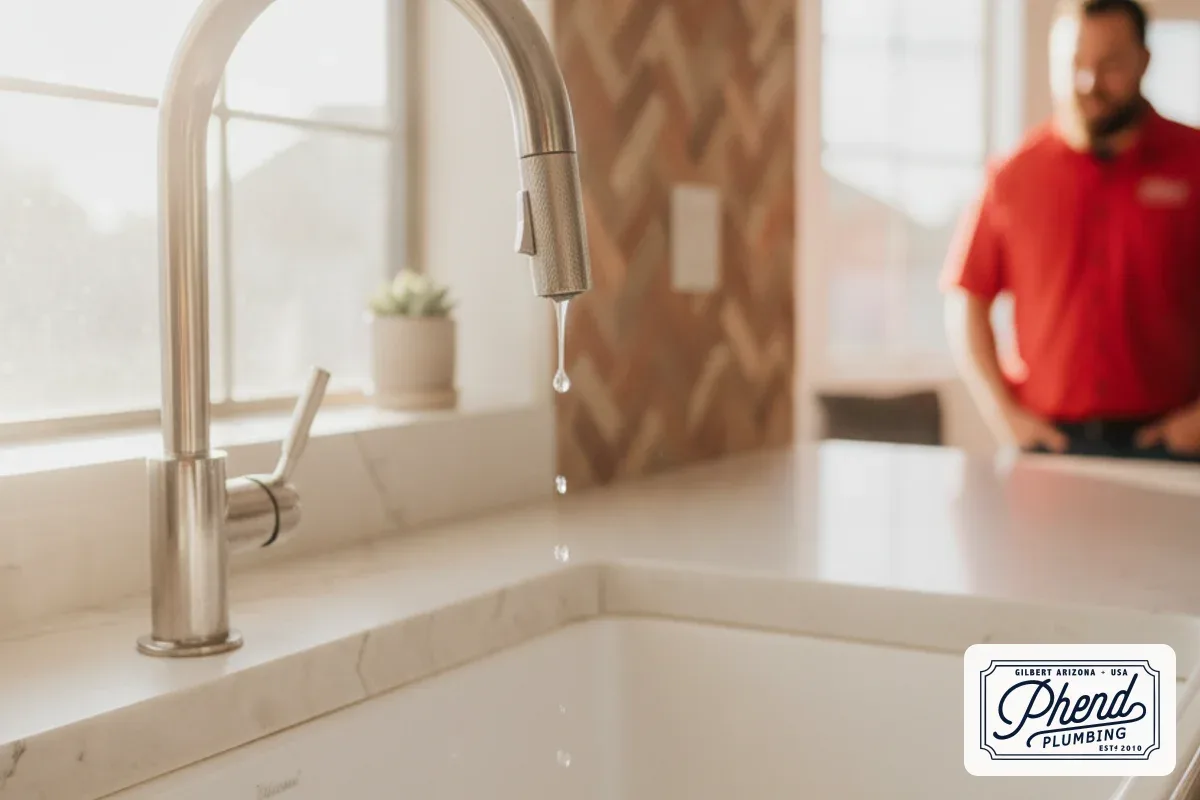
You have been meaning to make the call for three months. Every morning you hear that drip, every night you hear it again, and every time you think about scheduling a faucet installation you find something else to do first. You are not alone. Most Scottsdale homeowners wait far longer than they should on a dripping faucet, and that wait costs real money in a desert city where every gallon counts.
Before you pick up the phone, it helps to know what you are actually dealing with. Is this a quick cartridge swap, or does the whole fixture need to go? The answer changes the scope and the cost. In Scottsdale’s hard-water environment, it also changes how long any fix will last. This guide walks you through the diagnosis so you can have a smart conversation with your plumber instead of just describing a sound.
That Drip Has Been Going Three Months: What It Is Actually Costing You in Scottsdale
According to the EPA WaterSense program, a faucet dripping at one drop per second wastes approximately 3,000 gallons of water per year. That is roughly 250 gallons a month flowing straight down the drain. In a desert municipality where water conservation is a stated civic priority, that number matters beyond your utility bill.
Scottsdale Water sets tiered rates that increase as your usage climbs. A dripping faucet nudges you toward higher tiers month after month. Multiply that across a house with two or three problem fixtures and the math gets uncomfortable fast.
The good news is that most dripping faucets are fixable. The first step is figuring out exactly where the water is coming from.
Step 1: Locate the Drip: Spout, Base, or Handle Tells You Where the Problem Lives
Dry off the faucet completely and watch it for 60 seconds. Where does the water appear first?
Drip from the spout is the most common scenario. On cartridge-style and ceramic disc faucets, this almost always points to a worn valve cartridge or disc. The cartridge is the internal mechanism that controls water flow, and it is the part that Scottsdale’s hard water attacks first.
Leak at the base (where the faucet meets the sink deck) usually means an O-ring or mounting gasket has failed. This one can look minor, but it allows water to sit under the faucet, which can damage the sink deck or cabinet over time.
Drip from the handle area often signals a packing nut that has loosened or a stem seal that has degraded. On older compression faucets common in Scottsdale’s central neighborhoods built in the 1960s through 1980s, this is one of the more frequent failure points.
Write down what you see. That observation tells a licensed plumber which components to inspect first and whether a targeted repair is realistic.
Step 2: Diagnose Repair vs. Replacement: The Scottsdale Hard-Water Factor
Here is where Scottsdale’s water chemistry becomes the deciding factor. Municipal water in this area commonly runs 12 to 17 grains per gallon in hardness. That is a significant mineral load. Calcium and magnesium deposits accumulate inside ceramic disc and cartridge valves, grinding down sealing surfaces well before the brass faucet body shows any sign of wear.
What that means practically: a cartridge replacement on a faucet that is 8 to 12 years old is often the right first move, even before you consider replacing the whole fixture. The brass body of a quality faucet can outlast several cartridges. Condemning an otherwise solid fixture because the cartridge wore out is like replacing a car because the brake pads are thin.
The Water Quality Association classifies water above 10.5 grains per gallon as very hard. Scottsdale sits firmly in that range, which is why cartridge wear here outpaces what you would see in lower-hardness markets.
That said, there are situations where replacement wins:
- The faucet is more than 15 to 20 years old and has had multiple cartridge failures
- The body shows visible corrosion, pitting, or finish failure
- You are remodeling and want a fixture that matches updated hardware
- The faucet uses obsolete parts that are no longer available
If none of those apply, a cartridge swap is a legitimate, honest first step. Any plumber who defaults immediately to replacement without evaluating the cartridge is not giving you the full picture.
Step 3: Check the Shut-Off Valves and Supply Lines Before Anyone Touches the Faucet
This is the step most DIY guides skip entirely, and it is the one that causes the most surprises.
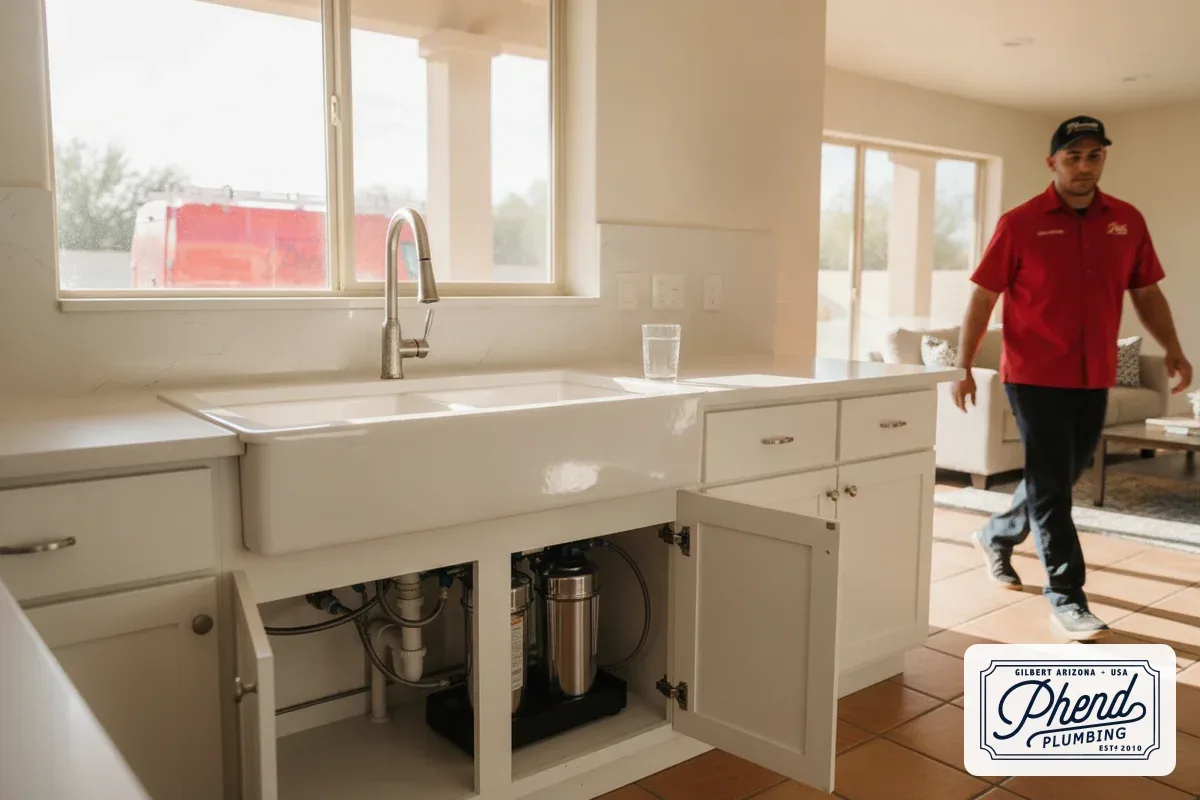
Before any faucet work begins, open the cabinet under the sink and take a close look at the angle-stop shut-off valves. These are the small valves on the hot and cold supply lines. In Scottsdale homes built before 1990, those valves may have never been turned off in decades. Mineral scale and corrosion can fuse the valve stem in place.
Trying to shut off a corroded angle-stop to replace a faucet can cause the valve to fail entirely, turning a one-hour faucet swap into an emergency water shutoff at the street. Phend Plumbing technicians check those valves first, every time, before touching the faucet.
Also look at the supply lines themselves. Braided stainless steel supply lines have a recommended service life, and if yours are original to the house, they may be approaching or past it. The International Association of Certified Home Inspectors notes that supply line failures are a leading cause of non-weather-related water damage in homes. Replacing them during a faucet swap is inexpensive insurance.
If either the valves or the supply lines look questionable, that needs to be part of the conversation before the faucet work starts.
When a Repair Is Enough and When It Is Not: A Practical Decision Framework
Use this as a quick mental checklist before you call:
Lean toward repair if:
- The drip is from the spout on a faucet that is less than 15 years old
- The faucet body is in good condition with no visible corrosion
- The cartridge or disc is available and reasonably priced
- You have not had repeated failures on the same fixture
Lean toward replacement if:
- The faucet has had two or more cartridge repairs in the past few years
- The finish is failing or the body is corroded
- You are doing a bathroom or kitchen update and want consistent hardware
- The fixture is a compression-style faucet on an aging copper supply system in an older Scottsdale home, where the whole under-sink assembly may need attention anyway
Neither answer is automatically right. A good plumber gives you both options with honest context, not just the one that generates more revenue.
What Professional Faucet Installation in Scottsdale Actually Includes
When Phend Plumbing handles a faucet installation, the work does not start and stop at the fixture. Here is what a thorough service call covers:
Shut-off valve inspection and testing. We turn those angle-stops before we touch the faucet. If they are stiff, corroded, or not sealing properly, we let you know and give you the option to replace them at the same visit.
Supply line replacement. Original supply lines on a Scottsdale home that is 20 or 30 years old are a liability once disturbed. We recommend replacing them as a standard part of the swap.
Fixture installation and sealing. The faucet goes in level, properly torqued, and sealed at the deck to prevent water from migrating under the sink.
Drain assembly check. If the drain stopper or tailpiece shows wear, we flag it. Water damage from a slow drain leak under a cabinet is exactly the kind of thing that gets missed until it becomes expensive.
Pressure verification. We run both hot and cold through the new fixture before we pack up, checking for leaks at every connection point.
Phend Plumbing holds AZROC license #288046, which you can verify directly through the Arizona Registrar of Contractors. Arizona Revised Statutes require plumbing work beyond simple fixture swaps to be performed by or under the supervision of an ROC-licensed contractor. That license is your assurance that the work meets code and that you have recourse if something is not right.
You can also cross-reference what a code-compliant faucet installation looks like against the Uniform Plumbing Code standards maintained by IAPMO, which Arizona adopts as the basis for its plumbing code.
Call Phend Plumbing for Faucet Installation Serving Scottsdale from Our Mesa and Gilbert Offices
Phend Plumbing operates out of our Mesa and Gilbert offices, which puts us within practical same-day driving distance of Scottsdale zip codes including 85251, 85257, 85260, and 85266. We are a family-owned company with East Valley roots, not a franchise operation, and we have been doing this long enough to know that a rushed replacement recommendation is not honest service.
If you have a dripping faucet, a leaking base, or a kitchen or bathroom fixture that is overdue for an upgrade, give us a call. We will diagnose the situation, tell you whether a repair or replacement makes sense for your specific faucet and your home’s plumbing, and give you a clear estimate before any work starts.
Call Phend Plumbing at (480) 388-6093 to schedule your faucet installation or repair in Scottsdale. We will take a look at the full picture under that sink, not just the fixture you can see.
Phend Plumbing has served the East Valley and greater Phoenix since 2010, including Phoenix, Gilbert, Scottsdale, and Queen Creek. We take care of fixture installation and water heater service and just about anything else a home throws at you. Call (480) 388-6093 for a fast, honest estimate.