You pour a glass of water first thing in the morning and it comes out with a faint brown tint. You tell yourself the pipes just need to flush. Then a few weeks later a plumber patches a pinhole leak under the hall bathroom. Six months after that, another pinhole shows up in the kitchen. At some point, you stop calling these isolated incidents and start asking a harder question. That is where the conversation about PEX vs copper repipe usually begins, and it is a conversation worth having before the next leak shows up in a wall you cannot see.
If your East Valley home was built before the mid-1990s and still has its original copper plumbing, what follows is written directly for you.
Warning Signs Your East Valley Home Is Telling You It Needs a Repipe
Most homeowners rationalize the early signs. Discolored water on the first draw of the morning gets blamed on the city. A small pressure drop when someone flushes while you are in the shower gets blamed on the neighborhood. A single pinhole leak gets patched and forgotten.
These are not isolated problems. They are a pattern, and the pattern matters.
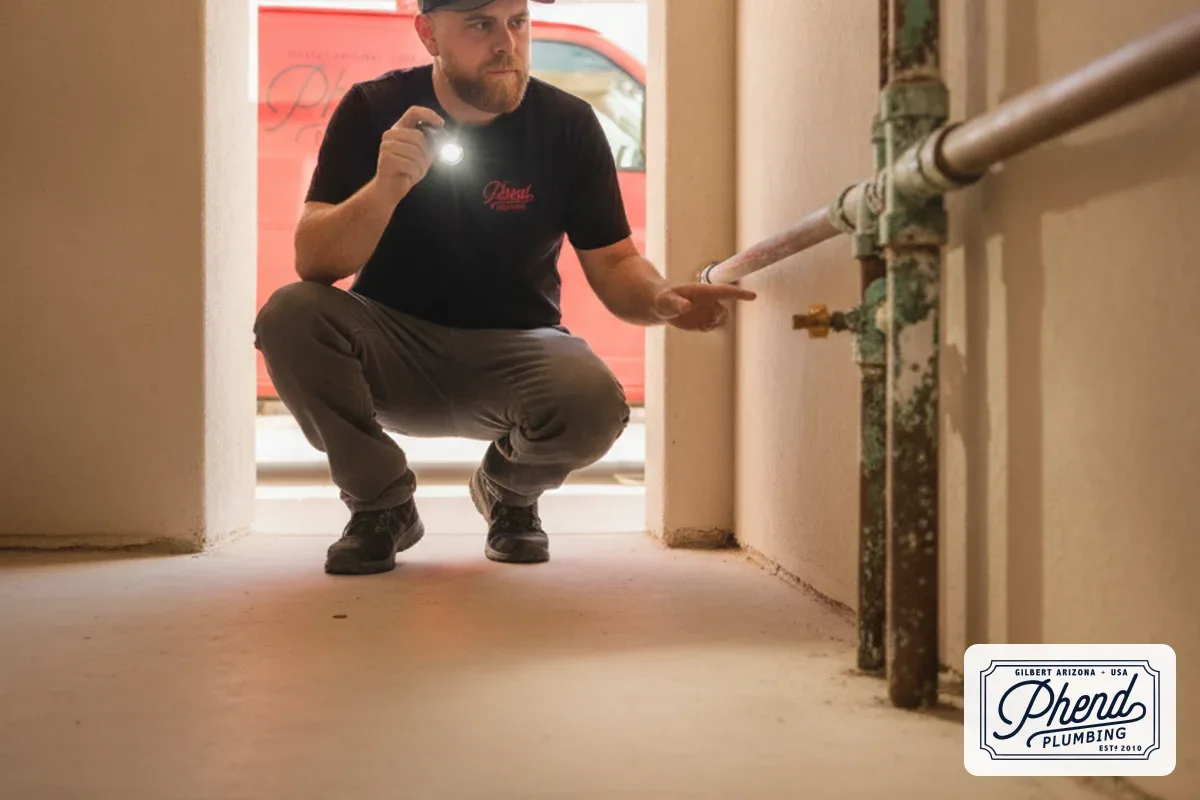
Discolored water, especially a rust or brown tint on the first draw, means the inside of your pipes is corroding and that corrosion is ending up in your glass. Low pressure at one fixture when another is running points to narrowed pipe walls from mineral buildup or internal corrosion. Recurring pinhole leaks in different locations mean the pipe material itself is failing, not just one bad section.
Other signs to watch for: visible green or white corrosion around fittings under sinks, water stains on ceilings or walls with no obvious fixture above them, and a water bill that creeps up without a change in your habits. Any one of these alone might be a one-time repair. Two or more together is your home telling you that one more spot fix is about to become twenty.
For more on what slab foundations add to this picture, check out our slab leak detection and repair overview, because pinhole leaks in the lines running under your slab are a separate problem that can develop alongside failing above-slab copper.
What Is a Whole-House Repipe and When Does One Repair Become Twenty
A whole-house repipe replaces all of the supply lines inside your home, from the main shutoff to every fixture, with new pipe. It is not a patch. It is a reset.
The work typically takes one to three days for a single-family home in the East Valley. A crew opens access points in walls and ceilings, routes new pipe through existing cavities, connects to all fixtures and shutoffs, and then patches the drywall. Your water is off for portions of each work day, but most families can stay in the home throughout the project.
The tipping point from repair to repipe is usually economic and practical. A single spot repair on a copper line costs a few hundred dollars. But if that same pipe system produces two or three pinhole leaks a year, you are spending that money repeatedly, each time with the risk that the next leak appears inside a wall or under a slab where the damage is far more expensive to address. At some point, the math flips. Replacing the whole system once costs less over the next decade than chasing failures through aging pipe.
For a broader look at the repipe process, our whole house repipe guide walks through what to expect from first call to final inspection.
PEX vs Copper: How Each Material Performs in Arizona’s Hard Water and Heat
This is where East Valley homeowners need information that most national articles skip entirely.
Phoenix metro water is classified as very hard, typically measuring 200 to 300 parts per million of dissolved minerals. That mineral load accelerates pitting corrosion inside copper pipe walls. Homes built before the mid-1990s are especially vulnerable because they were often plumbed with Type M copper, the thinnest-walled residential grade, which is more susceptible to the pinhole failures that chloramine-treated municipal water causes over time. East Valley cities including Mesa and Gilbert use chloramines as a disinfectant, and chloramines are harder on thin-walled copper than the older chlorine treatment methods.
You can verify your local water quality data directly through the EPA’s drinking water quality reporting resources or your city’s annual Consumer Confidence Report.
PEX, which stands for cross-linked polyethylene, does not corrode from mineral content. Hard water does not pit it, and chloramines do not degrade it the way they degrade copper. PEX has been used in U.S. residential plumbing for over 35 years and is rated to handle water temperatures up to 200 degrees Fahrenheit, which covers everything your water heater produces even on the hottest summer day.
PEX also requires fewer joints than copper because it flexes around corners and through wall cavities without fittings at every turn. Fewer joints means fewer potential leak points in a finished repipe. That is not a minor detail. Every soldered joint in a copper repipe is a future failure point if the solder or the pipe wall around it degrades.
Copper has real advantages too. It is rigid, which makes it easier to support in certain configurations, and it has a decades-long track record in residential plumbing. In a soft-water environment with no chloramines, copper can last 50 years or more. The problem is that the East Valley is not that environment.
The Plastic Pipe and Fittings Association publishes installation and performance standards for PEX that licensed contractors follow. The Copper Development Association provides comparable resources for copper. Both materials have legitimate applications. The question is which one makes more sense given your specific water chemistry and home.
Cost Comparison: PEX Repipe vs Copper Repipe in the Mesa and Gilbert Area
Copper prices are tied to global commodity markets and have been volatile in recent years. That volatility has made copper repipes significantly more expensive in material cost compared to PEX. Labor is also higher for copper because every joint requires soldering, which takes more time than the crimp or clamp connections used with PEX.
A PEX repipe on a typical three-bedroom, two-bathroom East Valley home will cost less than an equivalent copper repipe, sometimes meaningfully so depending on current copper prices at the time of your estimate. The gap widens on larger homes with more fixtures.
For an accurate number, you need an on-site estimate. Pipe runs, accessibility, the number of fixtures, and whether any lines run under the slab all affect the final cost. Call us at (480) 388-6093 and we will come out, assess your system, and give you a clear estimate without pressure.
One cost item that sometimes surprises homeowners is the permit. Arizona Revised Statutes require a plumbing permit for whole-house repipes, and that permit fee is part of the project cost. A licensed contractor pulls the permit and schedules the city inspection. If a contractor quotes you a repipe and does not mention the permit, ask about it directly.
Which Pipe Material Is Right for Your East Valley Home
For most East Valley homes with aging copper that is already showing pinhole failures or discoloration, PEX is the practical choice. It handles the local water chemistry better, costs less in materials and labor, and produces a finished repipe with fewer joints.
Copper remains a reasonable choice for homeowners who prefer it and are aware of the maintenance implications, particularly if the home has newer copper that is not yet showing signs of failure and the goal is a targeted replacement of a specific section rather than a full repipe.
If your home is on a slab foundation, which describes a large portion of East Valley homes built from the 1970s onward, the routing decisions for a repipe require extra thought. Lines that previously ran under the slab may need to be rerouted through walls and ceilings to avoid future slab leak exposure. PEX’s flexibility makes that rerouting more practical in most cases.
What to Expect During a Repipe With Phend Plumbing
We start with a walkthrough of your home to assess the existing pipe condition, map the fixture locations, and identify the best routing for new lines. We explain what we find in plain terms and give you a written estimate before any work starts.
Once you approve the work, we pull the permit with the city. In Mesa and Gilbert, that means filing with the city’s building department and scheduling an inspection before we close any walls. We handle all of that. You do not need to track down permit offices or inspection windows.
During the repipe, we protect your floors and work areas and minimize the number of wall openings needed by routing PEX through existing cavities wherever possible. Water is typically off for a portion of each work day, and most families stay in the home throughout. We patch drywall as part of the project scope.
After the inspection passes, the job is done. You have new supply lines throughout the home, a city-stamped permit on record, and no outstanding repair calls waiting to happen.
For a detailed look at how the permit and inspection process works specifically in Mesa, the City of Mesa Building Safety Division publishes permit requirements and inspection scheduling information.
How to Get a Repipe Estimate From a Licensed East Valley Plumber
Start by verifying the contractor’s license. Arizona requires a license through the Arizona Registrar of Contractors for plumbing work of this scope. You can search any contractor’s AZROC license number on the ROC website to confirm it is active and in good standing. A licensed contractor will pull the permit, schedule the inspection, and stand behind the work. An unlicensed one cannot legally do any of that.
When you call for estimates, ask each contractor whether the quote includes the permit fee, how they handle drywall patching, and what warranty they offer on the new pipe and fittings.
Phend Plumbing is a family-owned plumbing company serving Mesa, Gilbert, Chandler, Tempe, Scottsdale, Queen Creek, and communities across the East Valley. We have been doing repipes in this area long enough to know exactly what the local water does to aging copper, and we will give you a straight assessment of whether a repipe makes sense for your home or whether a targeted repair is the better call right now.
Call us at (480) 388-6093 or reach out through our East Valley repipe service page to schedule your estimate. There is no cost and no obligation to get an honest opinion from a licensed plumber who knows this market.
We are a local, family-owned crew working all over the Valley, Phoenix, Mesa, Tempe, and Chandler and the towns in between. Need whole-home repipe and drain cleaning? That is what we handle every day. Give us a call at (480) 388-6093.