The first question most Mesa homeowners ask when they start thinking about a repipe is not about the whole house repipe cost. It is: how long is my house going to be torn up? That is a fair question, and the honest answer is that most whole-home repipes take two to three days from first cut to patched drywall. If you want to plan your week around it, that is the number to work with.
This article walks you through exactly what those days look like, where the cuts go, what gets patched, and what drives the final price for Mesa homes. If you are dealing with pinhole leaks, low pressure, or a home full of aging copper, keep reading.
How Long Will Your House Be Torn Up? The Real Repipe Timeline in Mesa
Two to three days is the honest answer for most single-family homes in Mesa. A larger home with more fixtures or complicated routing might push toward the longer end. A smaller house or a targeted partial repipe could wrap faster.
Here is the part that matters most: you will have water at the end of each workday. The crew shuts the water off to work during the day, runs new pipe, and restores service before they leave for the night. Your family can use the bathrooms, kitchen, and showers while the job is in progress. It is an inconvenience, not a campout.
Phend Plumbing patches the drywall before the crew drives away. That is not the industry standard everywhere, so it is worth saying plainly. You will not be left with open walls.
Day-by-Day: What a 2-3 Day Whole-Home Repipe Actually Looks Like
Day one starts with a walk-through. The lead plumber confirms the access plan, marks the walls, and shuts the main water supply. The crew opens access points at key locations, usually inside cabinets, in the attic if the home has attic routing, and occasionally in closets. They pull the old supply lines and begin running new pipe.
For a typical three-bedroom Mesa home, most of the rough-in work happens on day one. By the end of that first day, the new pipe is roughed in and water is restored so your household can function overnight.
Day two is for finishing the connections at each fixture, installing new angle stops and supply lines at sinks and toilets, connecting to the water heater, and pressure testing the whole system. If anything needs adjustment, it happens now before the walls close.
Day three, for homes that need it, is for drywall patching and final inspection. On a two-day job, patching happens at the end of day two. Either way, you are not waiting a week for a separate drywall crew.
Where the Access Cuts Go and What Gets Patched Before We Leave
Mesa homes built on slab foundations present a specific routing challenge. Unlike homes with crawl spaces where supply lines run underneath the floor, slab homes route water lines through the walls and sometimes through the attic. That changes where the cuts go.
Typical access points on a Mesa slab home include the wall cavity behind the kitchen sink, the wall or cabinet space around bathroom vanities, the area near the water heater, and any utility closet that serves as a distribution point. Attic routing is common in East Valley homes and lets us run new lines overhead without cutting into finished walls at every fixture.
Every access hole gets patched before the crew leaves. We use drywall scraps cut to fit, secure them properly, and mud the seams. Texture matching and paint are a separate conversation because matching existing wall texture and color is a finish trade, not a plumbing trade. But the wall will be closed and structurally sound when we are done.
Whole House Repipe Cost in Mesa, AZ: What Drives the Price
Whole house repipe cost in Mesa, AZ depends on four main variables: pipe material, home size, the number of fixtures, and how complicated the routing is.
Real homeowner data from the East Valley area gives you a realistic range. All-copper repipes with soldered joints have come in around $13,000 on the lower end, with larger or more complex homes reaching $18,000 or more before any drywall or stucco repair work. Polybutylene replacement projects, which are a different material scenario but a comparable scope, have ranged from approximately $5,500 and up in the Mesa area depending on home size and labor involved.
PEX-A repipes generally cost less than all-copper because the material itself is less expensive and the installation is faster. The labor savings on a PEX job can be meaningful on a larger home.
What does not change regardless of material is the permit cost and the inspection. Mesa requires a plumbing permit for a whole-home repipe. Phend Plumbing pulls the permit as part of the job under Arizona ROC license number 288046. The permit fee is part of your quote, not a surprise add-on.
Stucco repair on the exterior is a separate line item if any exterior walls need access. Most Mesa homes route supply lines through interior walls and the attic, so exterior cuts are not always necessary, but it depends on the home.
Call us at (480) 388-6093 for a walk-through estimate. A real quote requires seeing the house.
PEX-A vs. Copper: Which Pipe Material Makes Sense for East Valley Homes
Mesa’s municipal water supply runs between 300 and 500 ppm hardness. That is classified as very hard water, and it is one of the primary reasons copper supply lines in East Valley homes develop pinhole leaks over time. The combination of hard water and chlorinated municipal supply is corrosive to copper, especially in older pipe that has already been stressed by years of Arizona summer heat pushing water temperatures up before it even reaches your fixtures.
PEX-A (cross-linked polyethylene, expansion type) is flexible, resistant to scale buildup, and does not corrode in high-mineral water. It handles freeze-thaw cycles better than copper, though that matters less in Mesa than in northern climates. It is also quieter under pressure, which homeowners with noisy pipes appreciate.
Copper has its own strengths. It is rigid, has a long track record, and is familiar to home inspectors and buyers. Some homeowners prefer copper for resale perception, and it is a legitimate choice when installed correctly.
Phend Plumbing installs both PEX-A and copper. We are not going to push you toward one or the other based on what is faster for us. We will show you the trade-offs for your specific home and let you decide.
For more on how pipe materials perform in high-mineral water environments, the Water Quality Association publishes consumer resources on water hardness and its effects on plumbing systems.
Why Mesa Homes Built in the 1970s-2010s Are Repipe Candidates
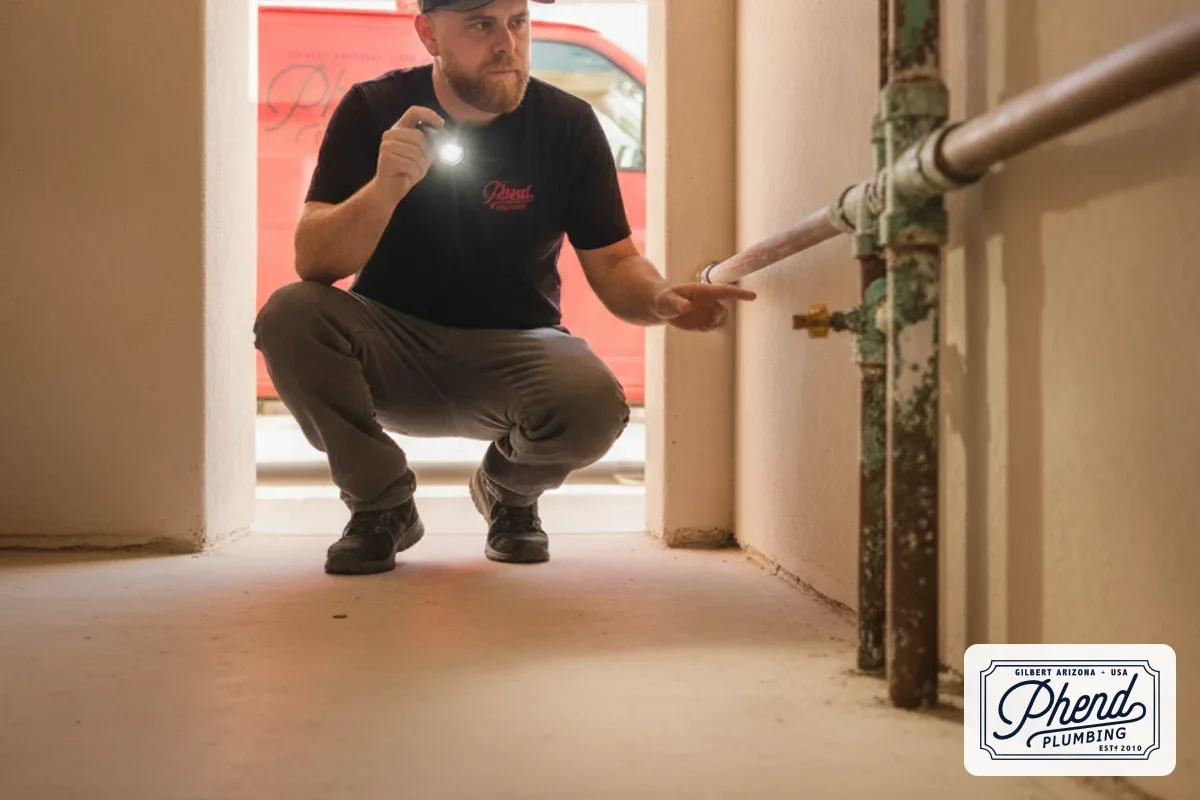
Copper supply lines installed in East Valley homes from the 1970s through the 2010s are now anywhere from 15 to 50 years old. That age range, combined with Mesa’s hard water and chlorinated supply, puts a large share of the housing stock in the zone where pinhole leaks become a recurring problem rather than an isolated event.
Homes built in the 1970s and 1980s often used thinner-wall copper (Type M) that is more vulnerable to corrosion than the thicker Type L or Type K used in commercial applications. Homes built in the 1980s through early 1990s sometimes used polybutylene, a gray plastic pipe that became notorious for failure and is a strong repipe candidate on its own.
Slab foundations, which are standard in Mesa, concentrate the risk. When a copper line running under or through a slab develops a leak, the repair options are rerouting through the walls or tunneling under the slab. At that point, many homeowners and plumbers have the same conversation: if we are already rerouting one line, does it make sense to do the whole house now?
Monsoon season (July through September) adds another stress factor. Soil movement from monsoon flooding can shift a slab foundation slightly, and that movement can stress supply lines that are already weakened by corrosion. We see a noticeable uptick in slab leak calls and repipe inquiries after heavy monsoon activity.
The EPA’s drinking water resources include data on chloramine and chlorine treatment levels that affect copper pipe longevity, and the City of Mesa Water Resources publishes annual water quality reports with local hardness and treatment data worth reviewing if you want the specifics for your neighborhood.
How to Get an Accurate Repipe Estimate from Phend Plumbing
There is no honest way to quote a whole-home repipe without walking the house. Anyone who gives you a firm number over the phone without seeing the home is guessing, and that guess usually moves in one direction when the crew shows up.
Here is what the estimate process looks like with us. You call (480) 388-6093 and schedule a walk-through. One of our plumbers comes out, looks at your current pipe configuration, counts fixtures, assesses the routing options, and asks about your priorities (material preference, timeline, budget range). You get a written quote that breaks out materials, labor, permit fees, and drywall patching.
We are a Mesa and Gilbert-based operation, licensed under Arizona ROC number 288046, and we have been doing this work in the East Valley long enough to know the quirks of local construction. We are not a regional chain dispatching crews from a call center. When you call our Mesa office, you are talking to people who know the neighborhoods, the soil, and the water.
If you are weighing whether spot repairs make more sense than a full repipe, that is a conversation worth having before you commit to anything. We will give you a straight answer on what we see, not a sales pitch.
Visit our Mesa plumbing service page or our whole-home repipe service page to learn more, or call us directly at (480) 388-6093 to schedule your estimate. You will know the real number and the real timeline before any work starts.
Frequently Asked Questions
Our service area runs across the whole Valley, Phoenix, Mesa, Tempe, and Chandler included, all covered by our Mesa and Gilbert offices. We do whole-home repipe and emergency plumbing and full-home plumbing, backed by straight talk and fair pricing. Reach us at (480) 388-6093.