When you are staring down a repair estimate that swings from $1,500 to $8,000 or more, the number that should come first is not the repair cost. It is the cost of not knowing. A sewer line camera inspection is the only tool that turns a plumber’s verbal assessment into documented footage you can actually use. And if you manage a commercial property in Gilbert, understanding what drives that price spread is the difference between a smart repair decision and an expensive guess.
This article walks you through exactly what a sewer camera inspection finds, how the footage determines whether you need a spot repair or a full replacement, and how to read an estimate so you are not walking into that conversation blind.
What a Sewer Camera Inspection Actually Costs in Gilbert, AZ (and Why the Range Is So Wide)
The inspection itself is a relatively small line item. The repair recommendation that follows is where the numbers move.
A spot repair on a single isolated problem, like one cracked section or a root intrusion at a single joint, typically runs $1,500 to $3,000 depending on depth, access, and pipe material. A full sewer line replacement on a commercial property can reach $8,000 or more once you factor in pipe length, excavation, and restoration of the surface above it.
What drives that spread is almost always one of four things: how much of the line is damaged, what the pipe is made of, how deep it is buried, and how difficult the access is. In Gilbert specifically, you also have to account for soil conditions and the age of the infrastructure, both of which we will get to in a minute.
The camera inspection does not add much to the total project cost, but skipping it is how commercial property owners end up paying for the wrong repair. A plumber who scopes the line and shows you the footage before recommending a repair is giving you something you can verify. A plumber who gives you a repair quote without a camera is asking you to trust a guess.
What the Camera Finds: Common Sewer Problems in Gilbert Commercial Properties
A fiber-optic camera threaded through your main line cleanout produces real-time footage of conditions inside the pipe. The National Association of Sewer Service Companies (NASSCO) maintains standardized pipeline condition assessment codes, which is the framework professional inspectors use to classify what they find. Here is what shows up most often in Gilbert commercial buildings.
Pipe bellies and dips. A belly is a low spot in the pipe where the grade has shifted and water pools instead of flowing toward the city connection. In a documented Gilbert inspection, the camera caught pooling and reverse water travel at the city connection point while the water inside the structure was completely off. That kind of belly causes chronic drainage problems that look exactly like a clog from inside the building. Without a camera, you snake it, clear the debris, and the problem is back in a month.
Buried or inaccessible cleanouts. The same Gilbert inspection found cleanouts buried under six to eight inches of gravel. That is not unusual in commercial properties where landscaping or resurfacing has happened over the years. Buried cleanouts add time and cost before the camera even enters the pipe.
Root intrusion. Tree roots find the smallest joint gap and work their way in. Once inside, they catch debris and restrict flow progressively until the line backs up entirely.
Offset or separated joints. Gilbert sits on caliche-heavy soil that shifts during the monsoon season (July through September) when moisture levels change dramatically. That ground movement can push pipe sections out of alignment over time, creating gaps that leak and collect debris.
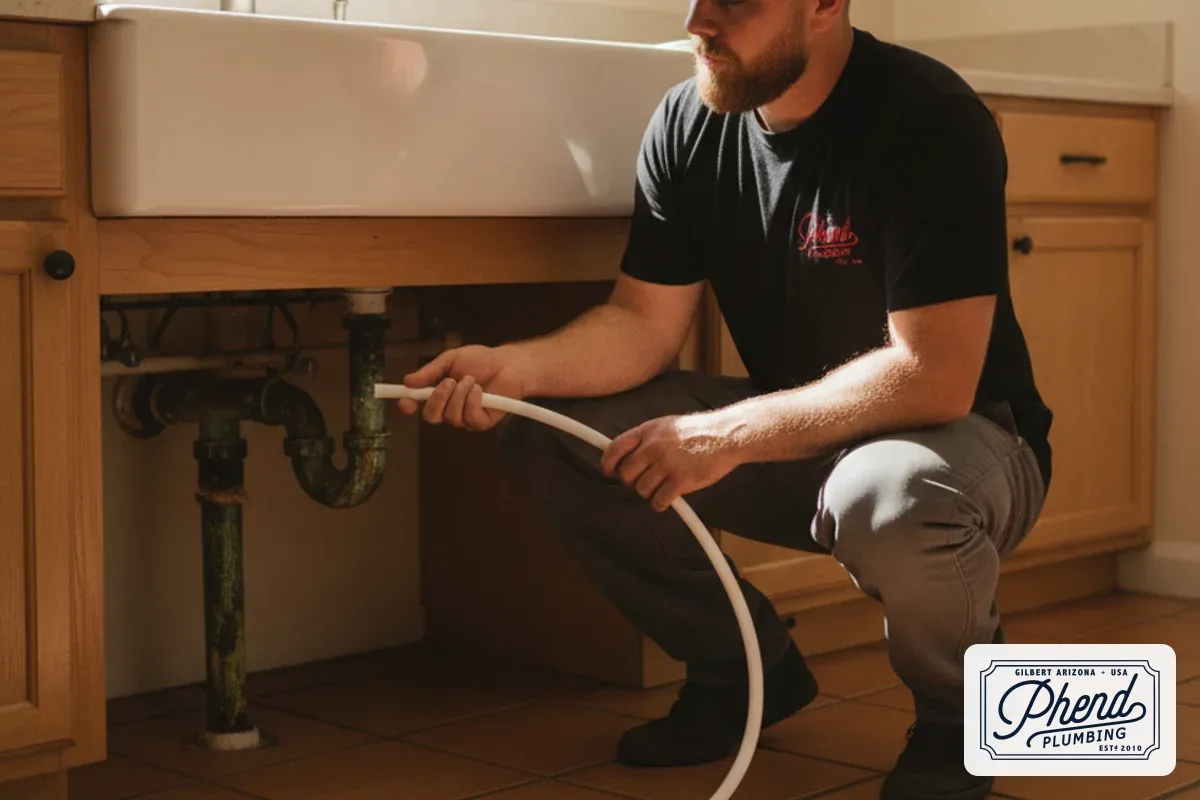
Pipe material degradation. Older commercial sections of Gilbert may still have ABS or clay pipe that has become brittle or cracked. Newer developments typically use PVC, which holds up better but is not immune to bellies or joint failure.
Spot Repair vs. Full Replacement: How the Footage Drives the Decision
This is the decision that determines whether you spend $2,000 or $8,000, and the camera footage is what makes it defensible either way.
A spot repair is appropriate when the damage is isolated to a single section and the rest of the line is in good condition. If the footage shows one offset joint or one root intrusion with clean, structurally sound pipe on both sides, a targeted excavation and repair of that section is a legitimate fix.
Full replacement is appropriate when the damage is distributed across the run, when the pipe material is too degraded to hold a repair, or when a belly or grade problem affects a significant portion of the line. You cannot spot-repair a belly because the problem is the slope of the pipe, not a single defect.
Here is where the footage becomes your leverage. When Phend Plumbing scopes a line, the recorded footage, not a technician’s verbal summary, drives the repair recommendation. You can take that footage to a second plumber and ask them to reference specific timestamps when explaining their bid. If a plumber recommends full replacement but cannot point to footage that justifies it across the length of the line, that is worth questioning.
The EPA’s Water Infrastructure resources and the American Society of Civil Engineers infrastructure reporting both emphasize that camera-based condition assessment is the baseline standard for any repair decision on aging sewer infrastructure. That standard applies to your commercial property too.
Why Gilbert’s Soil and Infrastructure Age Affect Your Repair Estimate
Gilbert has grown fast. Sections developed in the 1980s and 1990s have commercial sewer pipe that is now 30 to 40 years old. That generation of construction often used ABS pipe, which has a shorter service life than PVC and becomes brittle as it ages. Newer commercial developments use PVC, which is more durable but still subject to the same soil and grade challenges.
Caliche soil is the specific factor that separates Gilbert repair estimates from what you might see quoted in other parts of the country. Caliche is a hardened calcium carbonate layer that forms naturally in Arizona desert soils. Trenching through caliche requires more equipment time and sometimes specialized cutting, which adds to excavation cost. The Arizona Department of Environmental Quality tracks soil and groundwater conditions across the state, and caliche is a known factor in underground utility work throughout the East Valley.
Gilbert’s monsoon season also matters. The dramatic moisture swings from June through September cause soil expansion and contraction that stresses buried pipe joints over years of cycles. If your commercial property is older and you have never had a camera inspection, monsoon season is exactly the kind of long-term stress that shows up as offset joints and minor grade shifts in the footage.
Gilbert’s hard water (typically in the 300 to 500 ppm range) is less of a factor in sewer lines than in supply lines, but scale buildup inside older pipe can reduce interior diameter and contribute to debris accumulation at bellies and low spots.
What to Expect During a Commercial Sewer Camera Inspection in Gilbert
Phend Plumbing holds Arizona ROC license number 288046 and operates a Gilbert office in addition to its Mesa headquarters. The inspection process is straightforward.
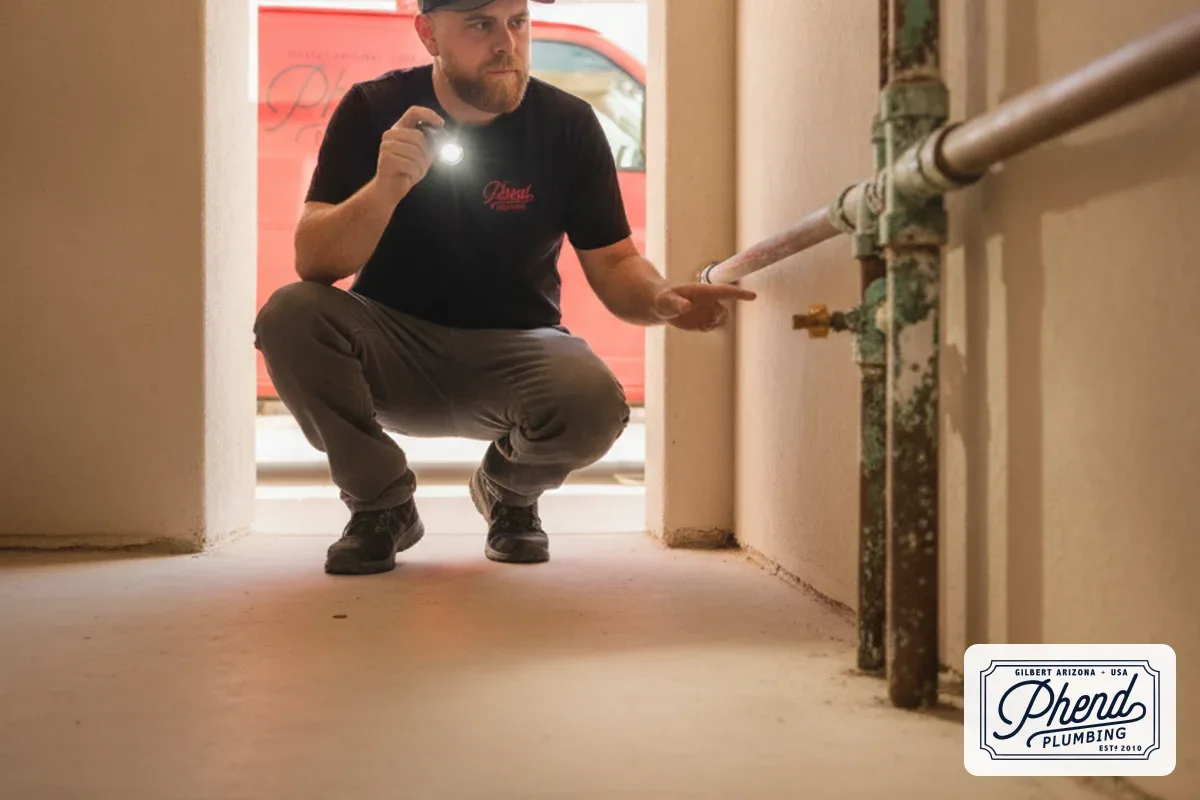
A technician locates the main line cleanout, which on a commercial property is usually near the building perimeter or in a utility access area. If the cleanout is buried or inaccessible, that gets addressed before the camera enters the line. The fiber-optic camera is then threaded through the full run from the building to the city connection, recording continuous footage of pipe condition, grade, joint integrity, and any obstructions.
The footage is reviewed with you on-site. Phend Plumbing’s process is camera-first: the recorded footage drives the repair recommendation, so you have a documented record before any repair work is discussed. That record is yours to use when comparing estimates.
Scheduling is available Monday through Friday from 7 a.m. to 5 p.m. and Saturday from 8 a.m. to 4 p.m., with 24-hour emergency service available when the situation cannot wait.
How to Read a Sewer Inspection Estimate Like a Pro
Once you have the footage, here is how to evaluate what a plumber puts in front of you.
First, ask them to tie every line item back to a specific finding in the footage. A legitimate spot repair recommendation will reference a timestamp or footage segment showing the isolated damage. A full replacement recommendation should show distributed damage across the run, not one bad section with otherwise sound pipe on either side.
Second, ask about pipe material. If you have ABS pipe that is 35 years old and showing brittleness throughout, a spot repair may hold for two years and fail again. If you have 15-year-old PVC with one offset joint from a soil shift, a spot repair is a reasonable long-term fix.
Third, ask about access and restoration. Excavation cost varies based on depth, surface material (concrete versus landscaping versus asphalt), and whether caliche is present. A low bid that does not account for surface restoration or difficult soil conditions is not a low bid once the job is done.
The Plumbing-Heating-Cooling Contractors Association (PHCC) recommends getting at least two bids on any commercial sewer repair over $2,000, and using the camera footage as the common reference point across both conversations.
Schedule a Sewer Line Camera Inspection with Phend Plumbing in Gilbert, AZ
If your Gilbert commercial property has slow drains, recurring backups, or a sewer line that has never been inspected, the camera is where you start. Not because it is a sales step, but because without the footage you are making a repair decision without the information you need to make it well.
Phend Plumbing serves Gilbert and the full East Valley from our Gilbert office. We scope the line, show you the footage, and give you a repair recommendation you can verify. Call us at (480) 388-6093 to schedule a sewer line camera inspection in Gilbert, AZ. We are available Monday through Saturday and around the clock for emergencies.
You should walk into any estimate conversation informed. The footage makes that possible.
From Phoenix, Gilbert, Scottsdale, and Queen Creek to the rest of the Phoenix area, Phend Plumbing shows up ready to work. Looking for sewer line repair and fixture installation? Our crews carry the parts and the experience. Call (480) 388-6093.