You probably did not wake up this morning thinking about your pipes. But if your water pressure has been dropping, your hot water looks a little orange, or you’ve had a plumber out twice in the past year for pinhole leaks, those are real signs you need a repipe. And once you get that news, the next question hits fast: PEX or copper? Most articles stop at the warning signs and leave you to figure out the material decision on your own. This one bridges both conversations because in the East Valley the choice of pipe material is directly connected to the conditions that wore out your old pipes in the first place.
PEX or Copper? The First Decision East Valley Homeowners Face During a Repipe
When a plumber tells you your home needs a repipe, you’re essentially being asked to choose a material that will carry your household’s water for the next several decades. That is not a decision to make under pressure without any context.
Copper has been the gold standard in residential plumbing for generations. It is durable, long-lasting, and has a proven track record in millions of homes. PEX, or cross-linked polyethylene, has been widely used in residential construction since the 1990s and is approved under the International Residential Code. It is flexible, resistant to scale buildup, and generally costs less to install than rigid copper because it requires fewer fittings and can be routed around obstacles without as many joints.
In a lot of the country, the freeze-resistance of PEX is a major selling point. PEX can expand slightly without bursting when water inside it freezes. In the East Valley, where temperatures rarely drop below freezing for any extended period, that advantage is largely irrelevant for most homeowners. So that talking point you will see in a lot of national plumbing articles does not really apply to you here in Mesa or Gilbert.
What does apply here is our water chemistry, and that changes the calculus significantly.
7 Signs You Need a Repipe in Your Mesa or Gilbert Home
Before diving deeper into material choice, you need to know whether a repipe is actually warranted. Here are the clearest indicators:
1. Consistently low water pressure throughout the house. One weak fixture might be a clogged aerator. Weak pressure at every faucet and shower points to buildup or corrosion inside the supply lines themselves.
2. Rust-colored or discolored water. Galvanized steel pipes corrode from the inside out. When that corrosion breaks loose, it shows up in your water. Homes in Mesa and Gilbert built before the 1980s may still have original galvanized supply lines that are well past their typical lifespan of 40 to 70 years.
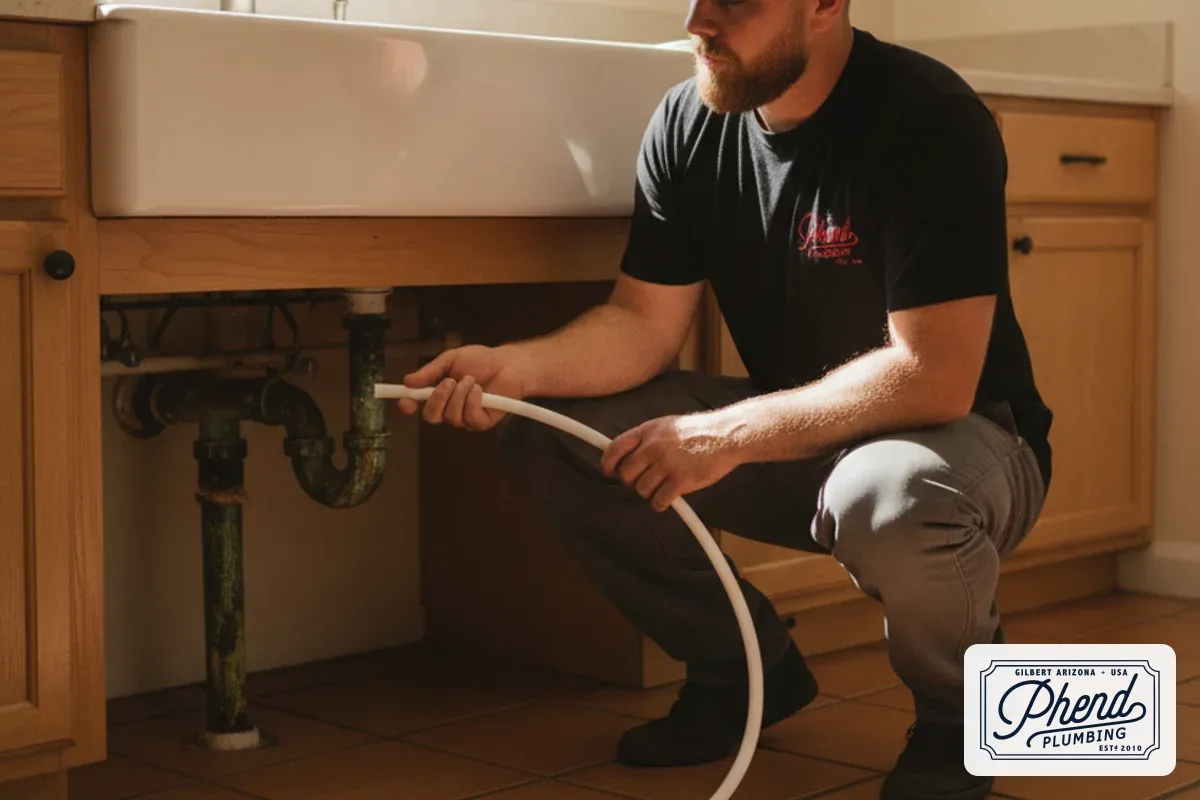
3. Recurring pinhole leaks. One pinhole leak might be a fluke. Two or three in different locations over a short period is a pattern, and it tells you the pipe material itself is failing.
4. Visible corrosion at pipe connections. Green or white mineral deposits around fittings, or obvious rust at joints, indicate the pipe is deteriorating at its weakest points.
5. Water that tastes or smells metallic. This often goes along with rust-colored water and indicates the pipe interior is breaking down and contaminating your supply.
6. Frequent pipe repairs that keep failing. If you’re patching the same system repeatedly, you’re spending money without solving the underlying problem.
7. A home built before 1980 with no known plumbing updates. This alone warrants an inspection. Galvanized and early copper systems from that era are reaching or exceeding their expected service life throughout the East Valley.
If two or more of these apply to your home, the next step is a professional evaluation. You can reach Phend Plumbing at (480) 388-6093 to schedule one.
How Arizona’s Hard Water and Heat Accelerate Pipe Deterioration
Here is something most national plumbing articles will not tell you: the conditions in the Phoenix East Valley are genuinely harder on pipes than what homeowners in most other parts of the country deal with.
Phoenix-area water is classified as very hard, typically measuring 200 to 300 parts per million of dissolved minerals. For reference, the U.S. Geological Survey classifies water above 180 ppm as very hard. At those levels, scale builds up inside copper pipes over time, gradually narrowing the interior diameter and reducing flow. That is the same mineral buildup you see on your showerheads and faucet aerators, happening invisibly inside your supply lines for years.
There is a second factor specific to our region. The Phoenix metro area’s water treatment system uses chloramines as a disinfectant. The EPA has approved chloramine treatment as an effective public health measure. However, some research has linked chloramine exposure to accelerated pitting corrosion in copper supply lines. Pitting corrosion is the mechanism behind those pinhole leaks that show up in copper pipes well before the end of their expected lifespan.
Add Arizona’s extreme summer heat to the equation. Temperatures above 110 degrees Fahrenheit stress water heaters and the supply lines connected to them. Hot water sitting in pipes during peak summer heat cycles can accelerate the chemical reactions that degrade pipe interiors over time. And because so many homes in Mesa and Gilbert are built on slab foundations, supply lines often run through or under the concrete, where they are exposed to ground minerals and moisture in ways that above-slab plumbing is not. Slab-routed pipes are also more difficult and expensive to access for repairs, which is one reason a full repipe is sometimes more cost-effective than repeated spot fixes.
PEX vs. Copper in the East Valley: An Honest Tradeoff Breakdown
Now that you understand what is working against your pipes in this climate, here is how the two main repipe materials stack up honestly.
Copper is a proven material with a long track record. It is rigid, which some contractors and homeowners prefer for visible supply runs. It handles high water temperatures well and does not require the same UV protection concerns as PEX in exposed outdoor locations. The downside in our region is susceptibility to chloramine-related pitting corrosion and scale buildup from hard water. A copper repipe in the East Valley may have a shorter functional lifespan than the same installation in a softer-water market.
PEX resists scale buildup better than copper because its smooth interior does not give minerals the same surface to adhere to. It is not susceptible to the same chloramine-related pitting corrosion. It is flexible, which means fewer fittings and fewer potential leak points during installation. It typically costs less to install than copper for the same reason. The flexibility also makes it easier to route through a slab-foundation home without as much cutting. The tradeoffs are that PEX cannot be used in some outdoor exposed applications without protection, and it has a shorter track record than copper, though the Plastic Pipe Institute and building codes have supported its use for decades.
For East Valley homes specifically, the combination of chloramine water treatment and hard water tips the practical advantage toward PEX for most homeowners.
What Most East Valley Plumbers Actually Install Today (and Why)
If you ask around among experienced East Valley plumbers, you will find that PEX has become the dominant choice for residential repipes in this market. That is not a coincidence or a cost-cutting measure. It reflects the real-world performance of both materials in this specific climate and water chemistry environment.
New construction throughout Mesa, Gilbert, Chandler, and the broader East Valley has shifted heavily toward PEX over the past two decades. That tells you something. Builders who are responsible for long-term structural integrity and who face warranty claims choose materials based on performance in local conditions, not national marketing.
Copper repipes are still performed and are still a legitimate choice, particularly for homeowners who want the longest-established track record or who are replacing a small section of pipe in an otherwise copper system. But for a whole-house repipe in a pre-1980 Mesa or Gilbert home with hard water and chloramine exposure, most experienced local plumbers will recommend PEX.
Whatever material is used, make sure your contractor holds a current license from the Arizona Registrar of Contractors. AZROC licensing is required for plumbing contractors performing repipe work in the state. Ask for the license number before authorizing any whole-house project and verify it on the AZROC website. This protects you if anything goes wrong and ensures the work meets Arizona code requirements.
What to Expect During a Whole-House Repipe in the Phoenix Area
A whole-house repipe is a significant project, but it is also a well-defined one. Here is what the process typically looks like.
First, a licensed plumber walks through your home to assess the existing system, identify the scope of work, and confirm the material recommendation. For a slab-foundation home, that walk-through will include evaluating how supply lines are currently routed and what access points exist.
Once you approve the estimate, the crew will typically begin by shutting off the main water supply and systematically replacing the supply lines throughout the home. PEX installation moves faster than copper in most cases because the flexible tubing can be snaked through walls and around existing framing with fewer cuts. Copper requires more precise measuring, cutting, and soldering at each joint.
Most three- or four-bedroom homes in Mesa and Gilbert are completed in two to three days. Your water will be off during active work periods but restored each evening when possible. After the pipe work is done, any drywall that was opened for access gets patched. Your plumber should also test the system thoroughly before the job is called complete.
When to Call Phend Plumbing for a Repipe Evaluation
If your home is showing any of the warning signs covered above, or if you’re in a pre-1980 Mesa or Gilbert home that has never had a plumbing update, a repipe evaluation is a smart next step. You don’t have to commit to anything. A professional look at your current system will tell you whether you’re dealing with an isolated issue or a system that is past its useful life.
Phend Plumbing is a family-owned company with offices in Mesa and Gilbert, and we serve homeowners throughout the East Valley. Our team handles whole-house repipes in PEX and copper, and we’ll give you a straight answer on which material makes sense for your specific home and water conditions.
Call us at (480) 388-6093 to schedule your free repipe evaluation. No pressure, no upsell, just an honest assessment from a licensed East Valley plumber who knows what our water does to pipes over time.
Wherever you are in the Valley, Phoenix, Mesa, Tempe, and Chandler or beyond, our trucks are already close. We handle whole-home repipe and water treatment with the same licensed team on every call. Dial (480) 388-6093 to book.