You have water damage on your floor, your bill spiked, and a plumber told you they need to find the slab leak before they can fix it. That makes sense. But when they mentioned equipment and detection, you nodded along without really knowing what comes next. What are they actually going to do at your house? What does “detection” look like in practice, and how does it lead to a real slab leak repair? This walkthrough answers those questions so you are not standing in your Chandler living room wondering what is happening and why.
Slab leaks in Chandler, AZ are more common than most homeowners realize. The hard water running through Maricopa County pipes carries mineral content between 300 and 500 ppm, and that level of mineral load accelerates corrosion on the copper lines embedded in your concrete foundation. Add Arizona’s summer heat pushing ground temperatures high enough to stress pipe materials, and you have conditions that produce pinhole leaks year after year across the East Valley. The good news is that slab leak detection and repair has become a precise, step-by-step process, not a guessing game.
What Your Chandler Plumber Is Actually Going to Do (And Why That Matters)
Most slab leak pages you find online lead with license numbers and pricing promises. What they skip is the actual process. That gap matters because an informed homeowner makes better decisions. When you understand why each step exists, you can ask the right questions, evaluate the answers you get, and know whether the plumber in front of you actually knows what they are doing.
The process Phend Plumbing follows has four phases: consultation, detection, confirmation, and repair planning. Each one feeds the next. Skipping or rushing any phase leads to either missed leaks or unnecessary concrete work. Here is how each phase works at your Chandler home.
Step 1: The Phone Consultation — What Phend Plumbing Needs to Know Before We Arrive
Before we schedule a detection visit, we ask you a set of specific questions. What symptoms are you seeing? A warm spot on the tile, running water sounds at night, a water bill that jumped by 30 percent, cracks near the baseboards? Each symptom points toward a different type of line. Supply line leaks under pressure tend to produce warm spots and audible water sounds. Drain line leaks are slower and show up more as moisture, odor, or foundation shifting over time.
We also ask about your home’s age and pipe material. Copper is the most common material in Chandler homes built before the mid-2000s, and copper is the material most vulnerable to the mineral corrosion that hard water causes here. Knowing what you have helps us calibrate the detection equipment before we arrive.
This call is not a formality. It shapes the entire visit.
Step 2: Electronic and Acoustic Detection — How We Find the Leak Without Tearing Up Your Floor
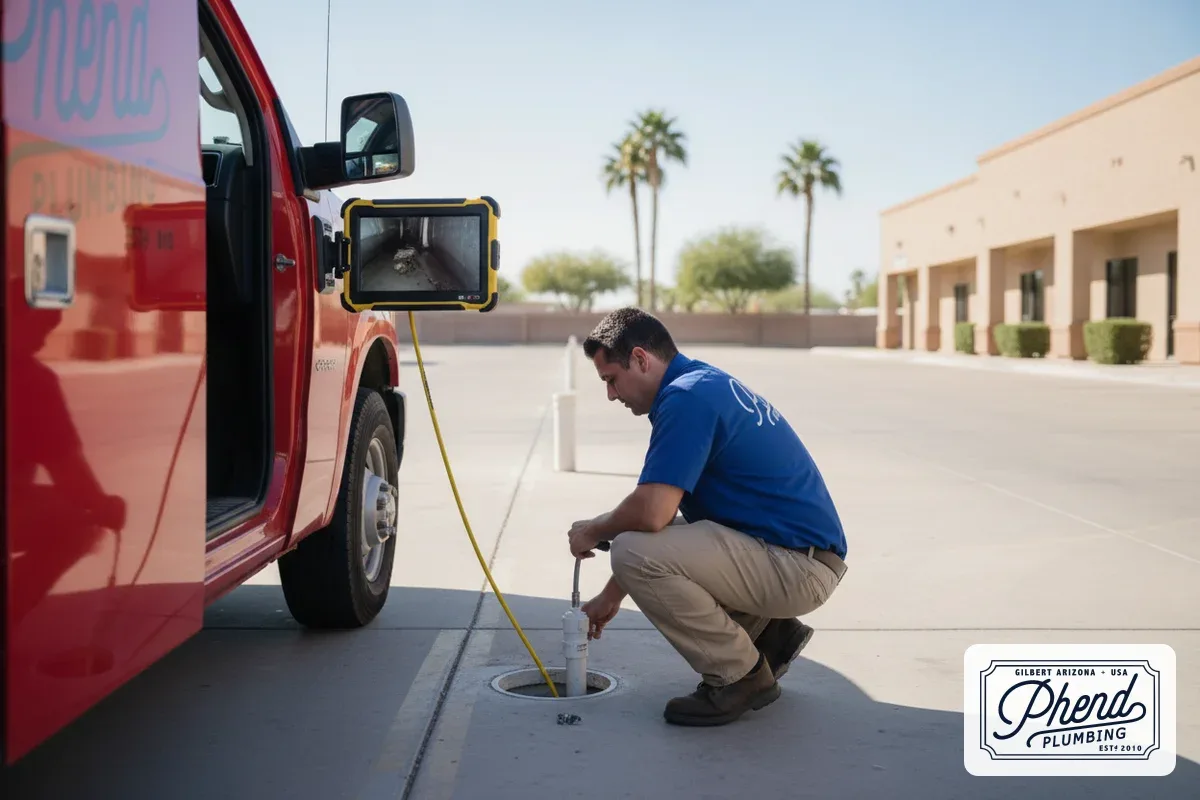
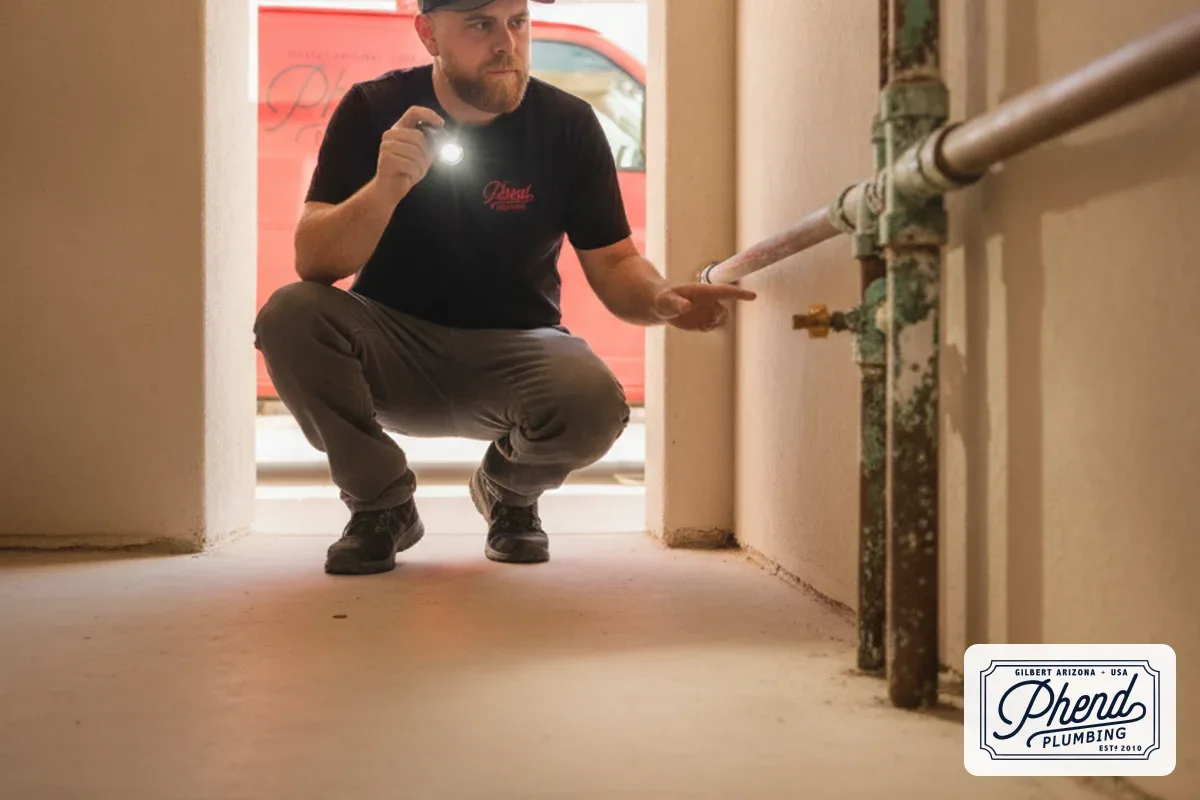
When we arrive, the first tools we use are non-invasive. Electromagnetic pipe-tracing equipment sends a signal through the pressurized line and maps its path through the concrete. This tells us exactly where each pipe runs under your slab, which matters because we cannot hear what we cannot locate.
Once we know the pipe path, acoustic listening devices come out. These amplify the sound of water escaping under pressure through the concrete and soil. Water moving through a pinhole or crack at line pressure produces a distinct sound signature that changes as the sensor moves closer to or farther from the source. A trained technician can narrow the leak to within inches using this method.
Using both tools together is the key. Electromagnetic tracing gives us the pipe route. Acoustic detection gives us the loudest point along that route. Together they define a small target area before any concrete is touched. The American Society of Plumbing Engineers recognizes electronic leak detection as the standard non-destructive approach for exactly this reason.
Step 3: Confirming the Leak Location — Pressure Testing and Pinpoint Marking
Electronic and acoustic detection narrows the area. A pressure isolation test confirms the specific line. We shut off individual supply lines one at a time and monitor the pressure gauge. When pressure holds after isolating a line, that line is not the source. When pressure drops, we have found the leaking pipe.
This step matters more than most homeowners realize. Your slab may have multiple lines running near each other. Acoustic detection can pick up the loudest signal, but without pressure isolation you cannot be certain which line is leaking or whether you are dealing with one leak or two. Skipping this step is how plumbers end up opening the wrong spot.
Once confirmed, we mark the floor at the leak point and walk you through exactly what we found before any repair conversation begins. You see the evidence, not just our conclusion.
For more on how pressure testing works in residential plumbing, the EPA’s WaterSense program provides useful background on leak detection methods and water loss from pressurized residential systems.
Step 4: Reviewing Your Repair Options — Spot Repair, Pipe Reroute, or Tunneling
Once the leak is confirmed and marked, you have three primary repair paths. The right one depends on the pipe type, the leak location, the condition of the surrounding pipe, and your flooring.
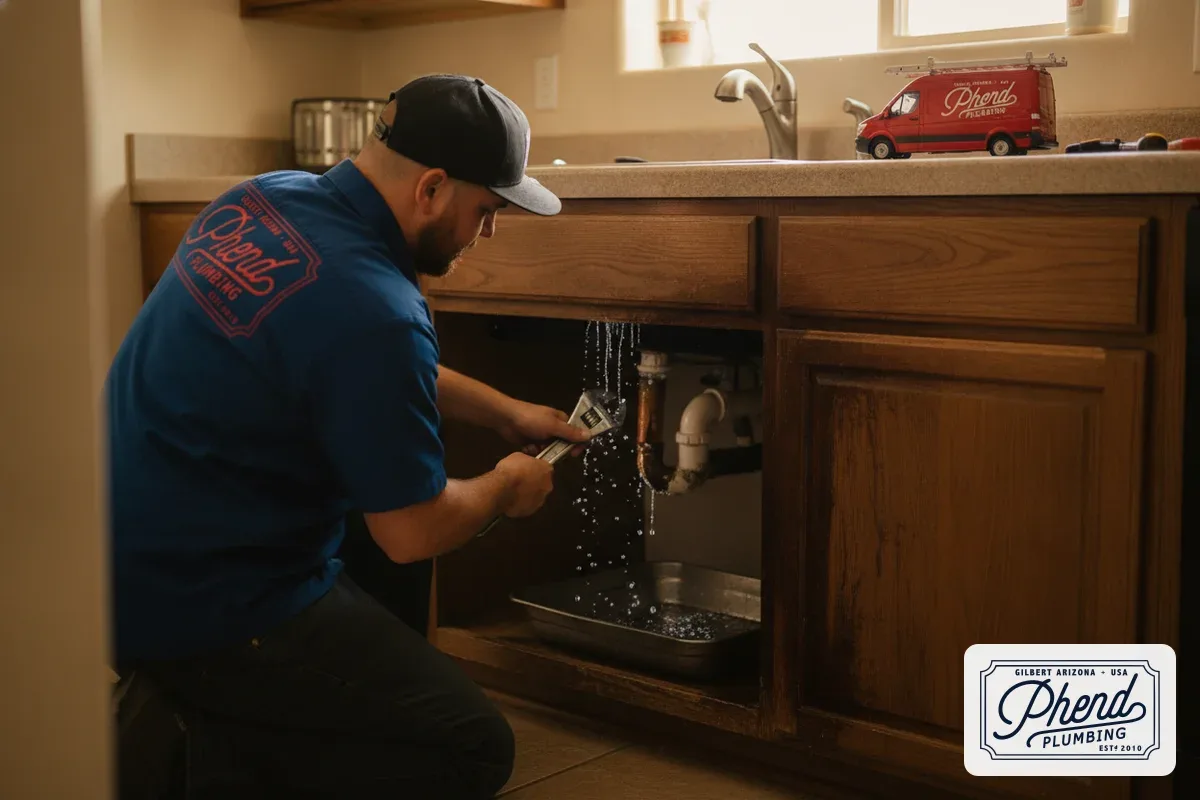
Direct-access spot repair means we open the concrete directly above the confirmed leak point, make the repair, and patch the concrete. This is the most targeted option and works well when the leak is isolated and the rest of the pipe is in good condition. The tradeoff is that you have a small section of broken-up flooring to restore.
Pipe rerouting abandons the damaged section entirely and runs a new line through your walls or attic to reconnect the affected fixtures. No concrete is opened. This is often the right call when the pipe has multiple corrosion points or when the leak is in a location that would require opening a large concrete area for access. For homes with expensive tile or hardwood, rerouting can be significantly less disruptive overall.
Tunneling means we excavate horizontally under your slab from an exterior access point and reach the pipe from below. Your interior flooring stays untouched. This method makes sense when flooring preservation is the priority and wall rerouting is not practical. Chandler’s caliche soil layer can add complexity to tunneling work, which is why the method needs to be evaluated site-specifically rather than assumed.
The Plumbing-Heating-Cooling Contractors Association outlines industry standards for each of these repair approaches, which gives you a reference point when evaluating any plumber’s recommendation.
We explain all three options, the pros and cons of each for your specific situation, and the cost difference before you make any decision. There is no pressure to choose on the spot.
What to Expect on Slab Leak Repair Day at Your Chandler Home
Repair day looks different depending on which method you chose. For a spot repair, we protect the surrounding floor area, open only the confirmed zone, complete the pipe repair, and pressure-test the line before patching the concrete. For a reroute, the concrete stays closed and the work moves into the walls or attic. For tunneling, the work starts outside and we keep interior disruption minimal.
In every case, we pressure-test the repaired line before we close anything up. You do not want to find out a week later that the repair did not hold.
One thing Chandler homeowners sometimes ask about is the monsoon season impact on slab leaks. Monsoon flooding from July through September can raise soil moisture around your foundation significantly, which changes the pressure dynamics on already-weakened pipe sections. If you noticed your symptoms get worse during or after a monsoon event, that context is worth mentioning when you call.
Phend Plumbing handles detection and repair as a single coordinated process. You are not hiring a detection company and then calling around for a repair plumber. One team, one point of contact, one clear chain of accountability.
You can verify our Arizona Registrar of Contractors license, number 288046, directly at the AZROC public license database. That license is required for all plumbing work in Arizona, and checking it takes about 30 seconds.
Why Chandler Homeowners Trust Phend Plumbing for Slab Leak Repair
Phend Plumbing is a family-owned company with physical offices in Mesa and Gilbert. We are not a national brand with a call center routing your job to whoever is available. When you call us, you reach a team that works the East Valley every day and knows the soil conditions, water quality, and housing stock in Chandler specifically.
We walk you through every step before we start, give you a written estimate before any work begins, and do not move forward without your sign-off on the repair plan. That is not a policy statement. That is how we have operated since we opened.
If you are seeing the signs of a slab leak under your Chandler home, do not wait. Water moving under your foundation causes damage that compounds quickly. Call Phend Plumbing at (480) 388-6093 and we will schedule a detection visit, walk you through what we find, and give you a clear path forward.
Phend Plumbing serves homeowners and businesses across the Valley, including Phoenix, Mesa, Tempe, and Chandler. Whether you need slab leak detection and sewer line repair or routine maintenance, a licensed Phend crew is a short drive from your door. Call (480) 388-6093 to get on the schedule.