Better water at every tap. Cleaner drinking water under your sink.
East Valley municipal water is safe to drink, but it carries chlorine and chlorine-dioxide residuals (Mesa) or chlorinated and ozone-treated water (Gilbert) plus dissolved solids and enough residual taste and odor to make most homeowners reach for a filter jug. Phend Plumbing installs whole-home carbon filtration and under-sink reverse osmosis in Mesa, Gilbert, and across the East Valley. Get a free in-home water test first so you know exactly what you are dealing with.
If you live in Mesa or Gilbert, the water coming out of your tap meets federal safety standards, but it also carries disinfectant residuals, dissolved solids, and minerals that affect the way your water tastes, smells, and feels. Mesa adds chlorine and chlorine dioxide at the treatment plant. Gilbert uses ozonation plus chlorination. Both leave behind taste and odor compounds you can detect at the tap. The East Valley water treatment challenge is a combination of disinfection byproducts, sediment, and total dissolved solids that no single product handles completely. Phend Plumbing installs two complementary systems for this: whole-home carbon filtration at the point of entry, and under-sink reverse osmosis at the kitchen tap. Here is what each system does and why most East Valley homes benefit from pairing them.
What is actually in East Valley tap water
Before you buy a filtration system, it helps to know what you are actually filtering. Mesa and Gilbert source their water from a mix of Colorado River surface water and Salt River Project groundwater, both treated at municipal plants before delivery. The treatment process is effective, but it leaves traces that affect quality at the tap.
Chlorine and chlorine dioxide (Mesa). Mesa adds both chlorine and chlorine dioxide at the treatment plant. Chlorine dioxide is used specifically to reduce the formation of trihalomethanes, a regulated disinfection byproduct. Both leave residuals that affect taste and smell at the tap. Some homeowners describe a pool-like odor that intensifies in a hot shower because volatile compounds release into steam. Activated carbon (cartridge or backwashing) removes both at typical whole-home flow rates. Catalytic carbon adds margin and is the smarter long-term spec given that municipal treatment chemistry can change.
Ozonation plus chlorination (Gilbert). Gilbert uses ozone as a primary disinfectant inside its treatment plants, then adds chlorine before water enters the distribution system. The chlorine residual is what you smell at the tap. Ozone leaves no residual but can contribute to occasional taste and odor variation. Both are handled by the same activated carbon stage that a Mesa home would use, which is why Phend specs carbon filtration consistently across the East Valley.
Total dissolved solids. East Valley tap water carries dissolved minerals on top of the calcium and magnesium that show up as hardness. A water softener exchanges those calcium and magnesium ions for sodium ions, which addresses hardness scale on fixtures and appliances. But TDS as a total number does not drop much after softening, since you are swapping one dissolved solid for another. Reverse osmosis is the technology that actually drives TDS down, which is why it makes sense at the kitchen sink for drinking water even in homes that already have a softener.
Sediment. Surface water sources carry fine particulate. Mesa and Gilbert distribution systems add a small amount of pipe scale and sediment that accumulates in aerators, appliance inlets, and water heater elements over time. A sediment pre-filter ahead of a carbon stage protects the carbon media and extends its service life.
Phend offers a free in-home water test that gives you actual numbers from your tap before any system is quoted. You should know what your water looks like at the point of use, not just what the city annual water quality report says about the plant output.
Whole-home carbon filtration at point of entry
A whole-home filtration system installs at the point where the supply line enters your home, typically near the water softener or water heater. Every fixture, shower, and appliance in the house draws from it.
What it removes. A properly sized carbon or catalytic carbon filter removes chlorine, chlorine dioxide, sediment, taste, and odor compounds. It also removes chloramines if a utility ever switches disinfectant chemistry. It does not soften the water (that is a water softener job) and it does not drive TDS down to drinking-water levels (that is reverse osmosis). What it does is strip the disinfectant residuals and the taste and odor components that make tap water from the shower or the kitchen sink feel and smell like a public pool.
Why the shower matters. Most homeowners think of filtration as a drinking-water concern. Chlorine and chlorine-dioxide residuals also vaporize in a hot shower, where you inhale them as steam, and they can dry skin and hair over time. For households with members who have sensitive skin, eczema, respiratory sensitivity, or young children, whole-home filtration removes those compounds at every fixture, not just the kitchen tap.
Cartridge vs. backwashing systems. Smaller homes (under 2,000 square feet with two or three people) often do fine with a high-capacity cartridge carbon filter that is replaced on a set schedule, typically every six to twelve months depending on water use and incoming TDS. Larger homes or households with higher water demand are usually better served by a backwashing carbon filter that regenerates itself on a timer and does not require regular cartridge swaps. Phend sizes the system to your home square footage, the number of people in the household, and the incoming water test results.
Placement and sequencing. When a home also has a water softener, the typical sequencing is: sediment pre-filter, then whole-home carbon, then water softener. The carbon stage strips disinfectant residuals before they reach the softener resin. Chlorine and chlorine-dioxide residuals both degrade ion-exchange resin over time, slowly reducing softener service life. In this configuration, the filtration system is also protecting your softener investment.
Under-sink reverse osmosis at the kitchen tap
A reverse osmosis system at the kitchen sink is a point-of-use system: it treats water at the tap where you drink, cook, and fill a refrigerator ice maker line. It does not treat the whole house supply, and it does not need to.
How RO works. Reverse osmosis pushes water through a semipermeable membrane under pressure. The membrane passes water molecules through while rejecting dissolved solids, heavy metals, nitrates, fluoride, and most organic compounds. The result at the tap is water with TDS in the range of 10 to 50 ppm, compared to the 200 to 400 ppm typical of East Valley tap water. The taste difference is noticeable immediately.
Standard 4-stage and 5-stage systems. Most residential RO systems have three to five stages: a sediment pre-filter, a carbon pre-filter (to remove chlorine and chlorine-dioxide residuals before they damage the membrane), the RO membrane itself, and one or two post-filters for final polishing. A 5-stage system typically adds a remineralization cartridge that adds a small amount of calcium and magnesium back into the product water for taste. This is a legitimate preference choice, not a requirement.
Tank vs. tankless RO. Traditional RO systems include a pressurized storage tank under the sink. The system fills the tank slowly (membranes work at low flow rates), and the tank provides immediate flow when you open the tap. The tradeoff is storage tank space under the sink and the need to sanitize the tank during filter changes. Tankless RO systems (also called tank-free or direct-flow RO) produce water on demand without a storage tank by using a booster pump and a high-efficiency membrane. They fit in tight under-sink cabinets and eliminate the tank maintenance step. Phend installs both configurations and will tell you which fits your cabinet space and water use pattern.
The wastewater ratio question. Traditional RO membranes reject a significant amount of water during filtration. Older systems might reject 4 gallons of water for every 1 gallon of product water produced. That 4:1 ratio concerns some homeowners in a water-conscious state like Arizona. Modern membranes and permeate pumps have substantially improved this. Current residential RO systems commonly achieve 1:1 or 2:1 reject-to-product ratios, meaning far less water goes down the drain. Phend installs high-efficiency membranes as standard and will confirm the specific ratio for the system you are considering before installation.
Ice maker and refrigerator connections. Most under-sink RO systems can be plumbed to a refrigerator ice maker line and the water dispenser on the door. This eliminates the common situation where the refrigerator filter improves the taste somewhat but the water is still starting from 400 ppm TDS. A refrigerator filter is not the same as an RO membrane. If you have an existing refrigerator water line, Phend can connect the RO product line to it during the same installation.
Filtration and RO together: how they fit East Valley homes
Whole-home filtration and under-sink RO solve different problems. They are not redundant, and they are not the same product at different price points.
Whole-home filtration handles what comes out of every faucet and showerhead in the house. It removes the chlorine and chlorine-dioxide residuals (Mesa) or chlorine residual (Gilbert) and their associated taste and odor from the water you cook with, bathe in, and wash your clothes with. It does not produce drinking-water quality at the kitchen tap; it produces better household-use quality throughout the home.
Under-sink RO produces drinking-water quality at one point. It removes TDS to near-zero levels, which whole-home filtration does not do. The product water tastes different from softened or carbon-filtered water. For a family that goes through a lot of water, ice, or filtered-water cooking, a kitchen RO replaces the recurring cost of bottled water or countertop pitcher filters.
The combination that most East Valley homeowners end up with is a water softener for hardness, a whole-home carbon filter for disinfectant-residual removal and shower quality, and an under-sink RO for drinking and cooking. All three systems are independent. You can install them in stages. Phend installs each system on its own or as part of a staged plan depending on what the water test shows and what the homeowner wants to address first.
If your concern is scale on fixtures and inside your tankless water heater, the water softener spoke covers that story in detail. Filtration story is taste, odor, and drinking water quality. If you have a tankless unit, a whole-home filtration system that strips chlorine and chlorine-dioxide residuals also reduces the disinfectant exposure on your heat-exchanger metals, which is a smaller but real factor in tankless descale intervals.
What Phend free in-home water test actually tells you
Phend offers a free in-home water test before quoting any water treatment system. Here is what the test covers and why it matters for sizing.
The in-home test measures TDS at the tap, hardness in grains per gallon, pH, and free chlorine levels at the point of use. These numbers come from your specific tap, not from the city annual report, which measures water at the plant before it travels through miles of distribution pipe and into your home own supply lines.
TDS and hardness readings determine what combination of treatment makes sense. Most East Valley addresses on municipal supply read in the 200 to 400 ppm TDS range. Higher readings can show up in parts of Queen Creek, San Tan Valley, and eastern Mesa where the distribution run is longer, or in homes drawing from groundwater wells with higher mineral content. Those may benefit from a more aggressive filtration setup or a specific RO membrane rating.
Free chlorine residuals at the tap tell us how much carbon contact time the whole-home filter needs. East Valley chlorine levels vary by season, by distance from the treatment plant, and by how recently the city has flushed its mains in your neighborhood. Mesa adds chlorine dioxide on top of chlorine, which can produce specific odor signatures in households with new carpet, paint, or upholstery. A catalytic carbon media with adequate bed depth handles the high end of what the East Valley sees. An undersized or low-contact-time cartridge filter may remove most of it but not all of it.
The water test also rules out well water issues, elevated nitrates, or local contamination events that might require different treatment beyond standard filtration. Most East Valley homes are on municipal supply and test consistently, but the test is the right starting point before any equipment recommendation.
System maintenance and filter replacement
A water filtration or RO system only performs well if it is maintained. Here is what the typical East Valley homeowner should know about the service schedule for each type of system.
Whole-home carbon cartridge filters. Replacement every six to twelve months for a typical household. Cartridge life depends on the incoming TDS and chlorine load, the number of people in the household, and the cartridge rated capacity. Phend marks the installation date on every system and can set up a reminder schedule. A cartridge that is overdue does not just stop filtering; it can start releasing accumulated contaminants back into the water. Replace on schedule.
Whole-home backwashing carbon filters. These regenerate automatically on a programmed timer and do not require cartridge changes. The carbon media has a service life of five to eight years in a correctly sized system. The main service task is verifying the backwash timing and salt or potassium levels if the system is integrated with a softener on a shared control valve.
RO pre-filters. The sediment and carbon pre-filters on an RO system typically need replacement every six to twelve months. These protect the membrane, which is the most expensive component in the system. Skipping pre-filter changes shortens the membrane life.
RO membrane. Under normal East Valley conditions with proper pre-filtration, an RO membrane lasts two to five years. Signs it needs replacement are a rising TDS reading on the product water side, reduced flow rate, or an unusual taste returning to the product water after pre-filters have already been confirmed fresh.
RO post-filters and remineralization cartridges. These change on a schedule similar to the pre-filters, typically once a year.
TDS meter check. Phend recommends an inexpensive TDS meter under the sink near the RO tap. A spot check every few months tells you exactly whether the membrane is performing. Product water TDS above 50 ppm on a recently maintained system is a signal to check the membrane.
Call Phend Plumbing for water filtration in Mesa and Gilbert
Phend Plumbing serves Mesa, Gilbert, Chandler, Tempe, Queen Creek, San Tan Valley, Scottsdale, Apache Junction, Fountain Hills, Gold Canyon, Ahwatukee, and East Phoenix for water filtration and reverse osmosis installation. If you want a free in-home water test before any commitment, call (480) 388-6093 and we will schedule it. If you already know what you want to install, call the same number and we will walk through the equipment options and give you a written quote.
Recent work
Gallery

Common questions
Does my East Valley home already have a filtration system?
Most East Valley homes on municipal supply do not come with whole-home filtration or reverse osmosis installed as standard. Some newer builds in master-planned communities include a builder-grade water softener loop, but filtration and RO are typically added by the homeowner after move-in. If you are not sure whether your home has any water treatment equipment, look near the water heater, in the garage near the water main entry, or under the kitchen sink. A water softener is a tall cylinder with a brine tank next to it. An RO system is a compact set of filters under the sink with a small dedicated faucet. Whole-home carbon filters are typically a single large canister on the main supply line. If you do not see any of those, your home does not have treatment. Call Phend Plumbing at (480) 388-6093 and we can confirm during a free in-home water test visit.
How often do I need to change RO filters?
For a typical East Valley home, RO pre-filters (sediment and carbon) need to be changed every six to twelve months. The RO membrane itself lasts two to five years with proper pre-filter maintenance. Post-filters and remineralization cartridges change roughly once a year. The easiest way to track membrane performance is a TDS meter at the RO tap: if the product water TDS rises above 50 ppm, it is time to check the membrane. Phend marks the installation date and filter specs on every system we install so you have a clear reference for the service schedule.
What is the difference between a water softener and a water filter?
A water softener uses an ion exchange process to remove calcium and magnesium ions, the minerals that cause scale on fixtures, inside water heaters, and inside tankless heat exchangers. It does not meaningfully reduce total dissolved solids or remove disinfectant residuals. A whole-home carbon filter removes chlorine, chlorine dioxide (the disinfectants Mesa uses), sediment, and taste and odor compounds. Gilbert water uses chlorine plus ozonation and benefits from the same carbon stage. It does not remove hardness. They solve different problems, which is why many East Valley homes have both. An under-sink RO system goes further than either by reducing TDS to near-zero levels for drinking and cooking. The free water test Phend offers helps you figure out which system or combination fits your specific water and your priorities.
Will RO water taste flat or empty?
Some people notice that high-purity RO water has a different, sometimes slightly flat taste compared to tap water. This is because the mineral content that contributes to the taste of tap water has been removed. A 5-stage RO system with a remineralization cartridge adds a small amount of calcium and magnesium back into the product water, which most people find improves the taste and brings it closer to what they expect from high-quality bottled water. Whether remineralization is worth adding is a personal preference. Phend can install either configuration and replace cartridges during routine service visits.
Can I connect an RO system to my refrigerator ice maker?
Yes. Most under-sink RO systems can be plumbed to an existing refrigerator ice maker line and the water dispenser. This is typically a straightforward connection that Phend can complete during the same installation visit. The benefit is that your ice and chilled water draw from the RO product line at low TDS, rather than from the unfiltered tap supply that a refrigerator filter alone is working with. If your refrigerator does not currently have a water line, Phend can install one as part of the job. Call (480) 388-6093 to confirm the connection type for your specific refrigerator model.
Is a tankless RO system better than a tank-based one?
It depends on your cabinet space and usage pattern. A tankless RO system uses a booster pump to produce water on demand at higher flow rates than a gravity-fed membrane. It eliminates the storage tank (which takes up cabinet space) and the occasional task of sanitizing the tank during filter changes. The tradeoff is a slightly higher purchase cost and the pump requires a power connection under the sink. A tank-based system is simpler mechanically and costs less upfront, but the tank takes up space and needs attention during service visits. Phend installs both and will walk you through the fit for your cabinet and your household's daily water use before making a recommendation.
Can whole-home filtration protect my water softener?
Yes, and this is one of the stronger reasons to install both systems. East Valley municipal water carries chlorine residual (and Mesa also adds chlorine dioxide). Both disinfectants oxidize ion-exchange resin over time, slowly reducing the resin bed exchange capacity and shortening the service life of the softener. Placing a whole-home carbon or catalytic carbon filter before the softener in the supply sequence strips those residuals before the water contacts the resin. This extends the resin life and protects the softener investment. When Phend installs or retrofits a filtration system in a home that already has a softener, the sequencing question is always part of the planning conversation.
How do I schedule a water filtration installation or water test with Phend Plumbing?
Call (480) 388-6093 or use the contact form on the site. If you want to start with the free in-home water test, tell us that when you call and we will schedule a test visit with no obligation to proceed. The test gives you actual TDS, hardness, pH, and free chlorine numbers from your tap, which is the right starting point for any equipment recommendation. If you already know what you want installed, call with the system type and Phend will give you a written quote before scheduling the installation. Phend serves Mesa, Gilbert, and the full East Valley and can typically schedule within a few business days.
Know what is in your water before you buy anything.
Phend offers a free in-home water test that measures TDS, hardness, and free chlorine levels at your tap. The numbers tell you what system you actually need, not what is easiest to sell. Serving Mesa, Gilbert, and the full East Valley.
- Free in-home water test, no obligation
- Whole-home carbon filtration for chlorine and chlorine-dioxide removal
- Under-sink RO for drinking water at low TDS
- Written quote before any equipment is ordered
Pete on East Valley water quality and what to do about it.
Short reads from Pete on what is in your tap water, when a filter is enough versus when you need more, and how Arizona hard water affects every system in your home.
Ask Pete: can hard water cause long-term damage to your plumbing?
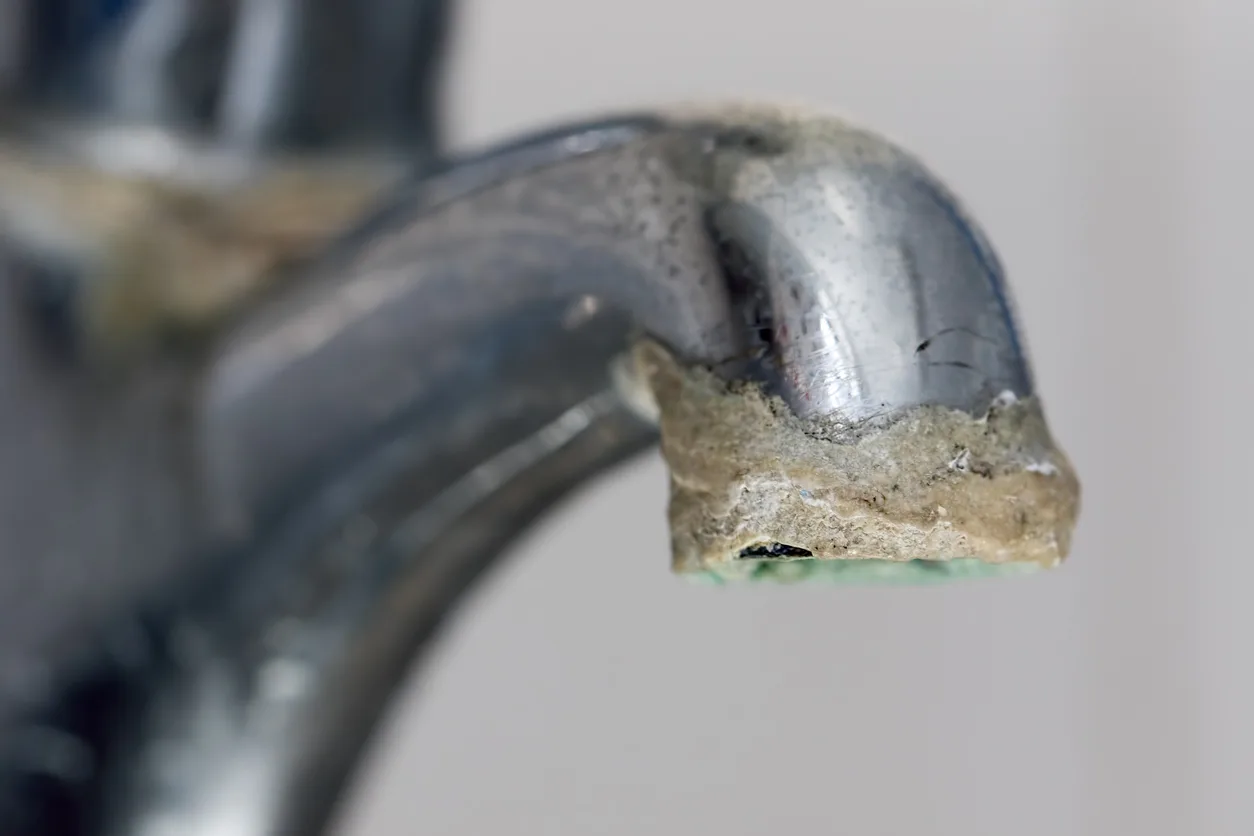
Mesa publishes 12 to 22 grains per gallon hardness, Gilbert 8 to 10. Both are hard enough to shorten fixture life and clog water heater elements. Pete explains what the damage actually looks like and when treatment pays for itself.


High-pressure shower performance: what water treatment actually changes.
Scale from hard water and disinfectant residual both affect shower pressure and how your skin feels. Pete covers what filtration and softening actually fix and in what order.
Ask Pete: how often should I schedule plumbing maintenance in Arizona?
Arizona hard water and extreme summer heat push a maintenance schedule that is different from most of the country. Pete walks through what to check annually and what can wait.